
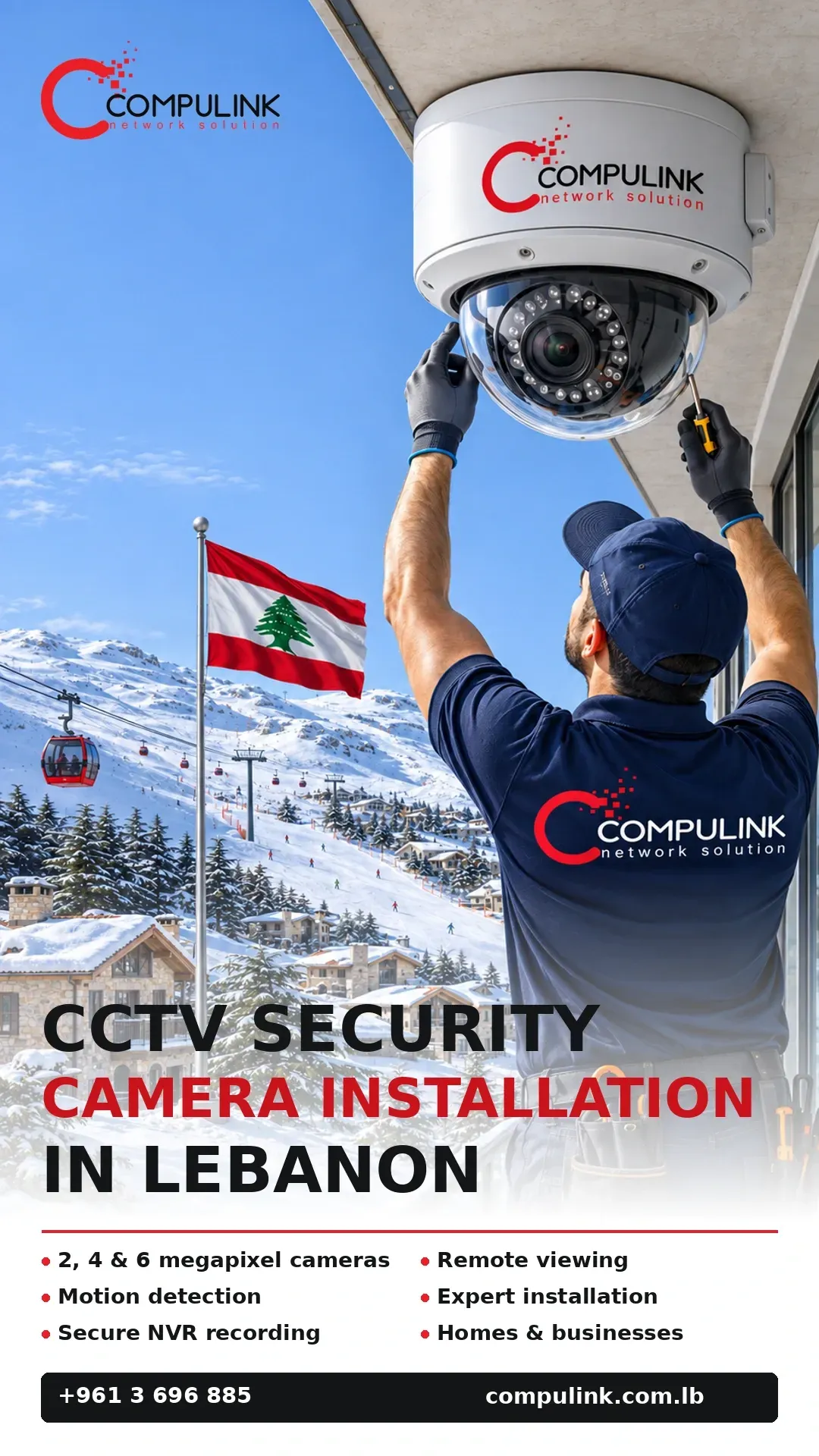
CCTV Installation in Lebanon

CCTV Installation in Lebanon by COMPU LINK starts with a site survey. We identify what each camera must capture, where it should be mounted, how the cable will reach it, and how long you need to keep footage. We primarily install Hikvision IP security cameras, with 2, 4 and 6 megapixel options selected for the scene.
A camera overlooking a warehouse floor serves a different purpose from one capturing faces at an entrance. Resolution, lens choice, viewing angle, and lighting all affect what you can see when you play back a recording.
For new camera runs, COMPU LINK uses solid-copper Cat6A cabling. A PoE camera receives power and sends video over the same Ethernet cable.
Some low-cost cables use copper-clad aluminum (CCA), an aluminum core with a thin copper coating. Its higher electrical resistance increases voltage drop, especially on long runs and when cameras draw more power at night.
A camera can appear to work during a daytime test and then restart or lose its feed when infrared illumination switches on.
We size each PoE switch for the maximum power each camera can draw and the combined load of all cameras.
We connect the cameras to dedicated CCTV switches on a separate routed firewall port.
That gives surveillance its own network, with firewall rules controlling who can view footage.
Before handover, we test camera views, night operation, recording, playback, and clip export.
When you compare quotations, ask for the cable conductor type, usable PoE budget, expected recording retention, and handover tests.
Those details tell you how the system is designed to perform after installation.

CCTV Installation in Lebanon: Why Choose COMPU LINK?
CCTV installation decisions can be expensive to revisit once the walls are closed. A camera can usually be reaimed or replaced at its mounting point, and an NVR can be exchanged at the rack. Replacing a concealed cable can require reopening finished ceilings or walls, pulling through crowded conduits, and disrupting an operating business. COMPU LINK plans cable routes and selects cabling for each camera before installation begins.
We specify solid-copper Cat6A and assess each run for length, routing conditions, and the camera’s maximum PoE demand. We calculate the power required per port and the total PoE switch budget, allowing for cable losses.
Excessive cable resistance can increase voltage drop, while poor terminations can disrupt data transmission. These faults can show up as frozen video, dropped feeds, or cameras that restart intermittently. We label and test each run before it is concealed, then verify camera operation under the expected load.
For outdoor copper runs, we specify outdoor-rated S/FTP Cat6A with compatible shielded terminations. We verify shield continuity and coordinate testing of bonding and earthing. Where routes are exposed to surges, we specify Ethernet surge protection and coordinate it with the site’s electrical protection.
A surge can travel along copper cabling and damage cameras, switches, the recorder, or other connected equipment. These measures reduce the risk. A direct lightning strike can still overwhelm them.
When comparing quotations, ask for the exact cable model, PoE calculations, and the cable and earthing tests included at handover. Those details show what will go behind the walls and how it will be verified before the routes are closed.

CCTV Cabling in Lebanon with Solid-Copper Cat6A
When you compare CCTV installation quotations, check the cable datasheet for three details: conductor material, conductor gauge, and DC resistance Open the PoE Cable Testing Guide (PDF). A PoE camera receives power and sends video over the same Ethernet cable, so the electrical quality of the entire run matters.
Solid copper has lower electrical resistance than an equally sized aluminum conductor. Within the same material, a thicker conductor generally has lower resistance. These are the measurable properties behind what buyers sometimes call copper density.
Copper-clad aluminum, or CCA, has an aluminum core with a thin copper coating. Its higher resistance can increase voltage drop on long runs, especially when cameras draw more power. A camera may pass a daytime test and then restart or drop its video feed when its infrared LEDs turn on at night. Patch leads and terminations also contribute to the electrical performance of the link.
COMPU LINK specifies
solid-copper Cat6A for permanent camera runs in new
CCTV installations across Lebanon. We review the manufacturer’s specifications, choose a cable jacket suitable for the installation environment, and confirm cable lengths and
PoE switch locations before pulling cable. We label and
test each completed run before connecting the cameras.
During commissioning, we verify that the cameras stay online and that the recorder continues capturing video when night mode activates. This helps catch intermittent faults before handover, when correcting a cable route or termination can involve reopening ceilings or walls.
Ask your installer to specify solid copper in the quotation and show you the cable datasheet, so you can compare what each proposal actually includes before you approve the work.
CCTV Camera Stability and PoE Switch Power Output
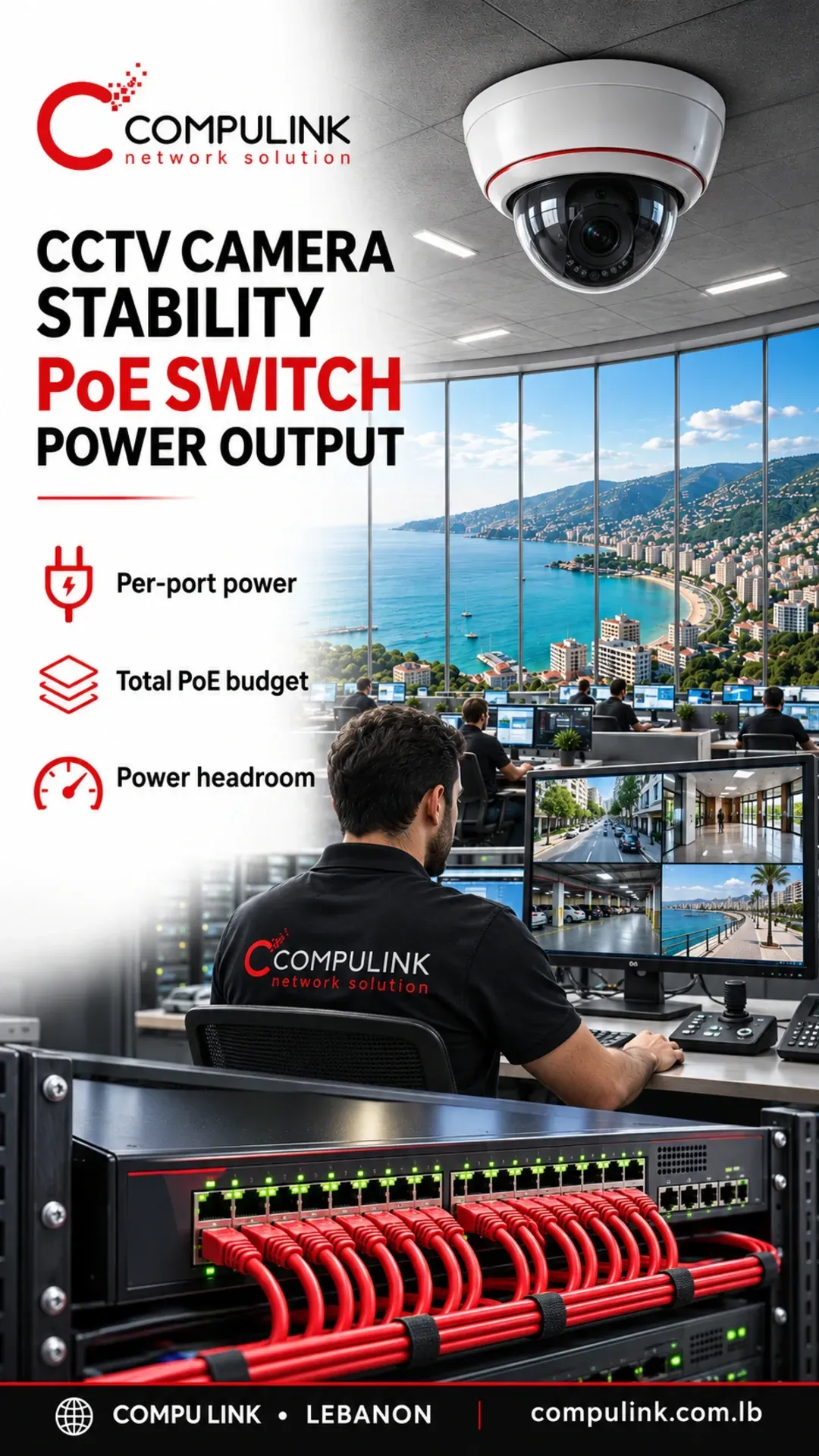
CCTV camera stability starts with sizing the PoE switch power output to match the cameras it will supply. At COMPU LINK, we use each camera’s manufacturer-rated maximum power draw as the design figure.
The camera draws the power it needs within its supported specification, and the switch port must be able to supply that requirement.
We check the required PoE standard and the power available per port before assigning cameras to the switch. Then we check the total PoE budget, which is the power the switch can supply across its ports at the same time.
A switch can have enough ports for every camera and still have too little usable power for the installation. For example, 12 cameras rated at 10 W each can require 120 W at the cameras. The switch must provide enough output to meet that demand after allowing for cable losses.
We also check how the switch reserves power for each port, since its PoE allocation can exceed a camera’s actual draw. We select a switch with enough power headroom to support the combined load and any agreed future additions.
During commissioning, we verify that the switch powers all cameras together, that their live feeds stay online, and that the NVR records without interruptions during the test.
When reviewing a CCTV installation quotation in Lebanon, ask for the exact switch model, its per-port power rating, its usable total PoE budget, and the maximum power draw of each camera model.
These figures show how the proposed switch was sized to keep the cameras powered and recording reliably under the expected load.
CCTV Network Segmentation Through a Dedicated Firewall Port
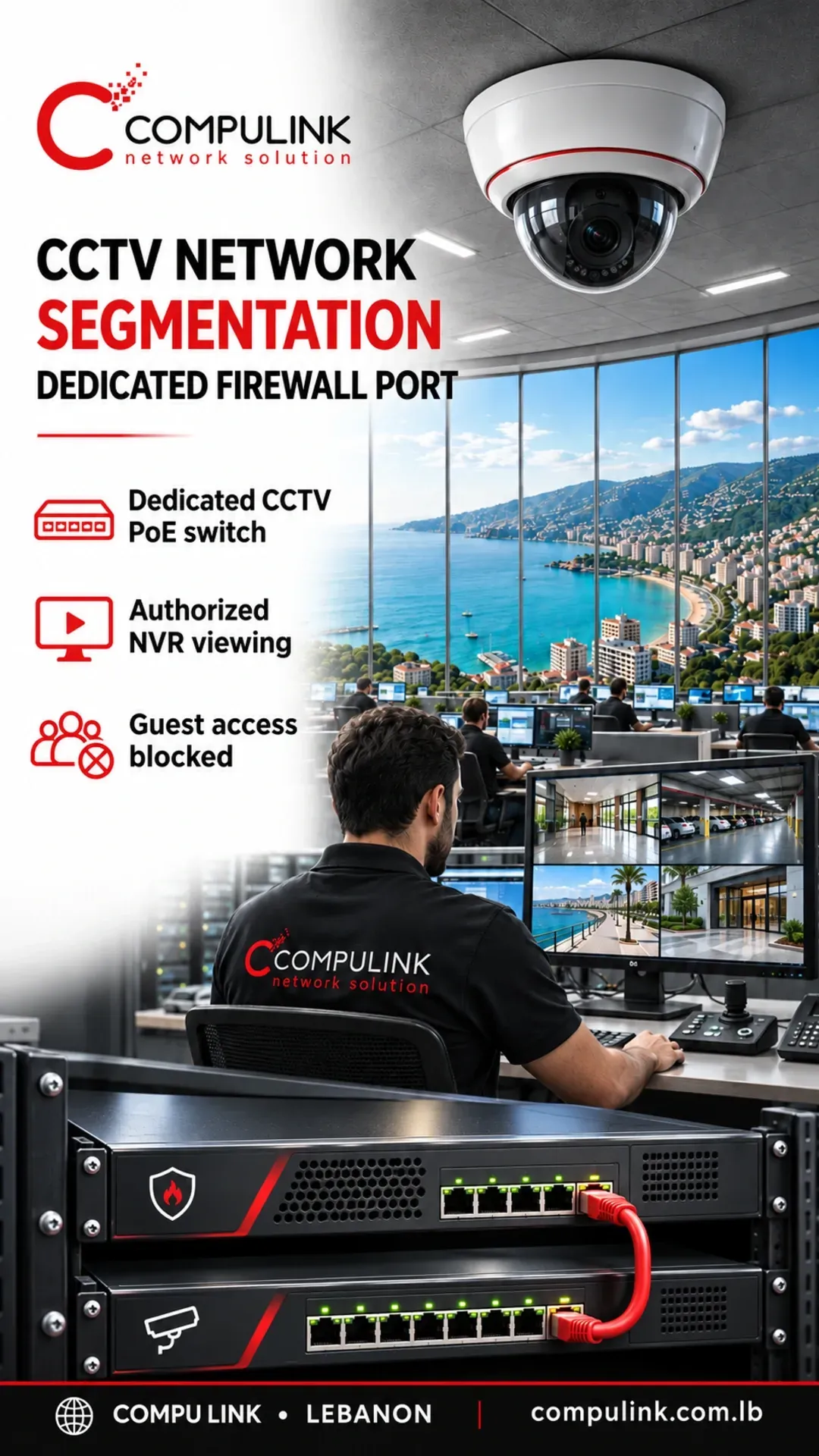
In a COMPU LINK installation, IP cameras connect to dedicated PoE switches reserved for surveillance. The CCTV switching infrastructure connects directly to a dedicated routed LAN interface on the firewall and uses its own IP subnet. Office computers, guest Wi-Fi, and other systems connect through separate network infrastructure. This design keeps traffic between surveillance and other networks under firewall control.
We block traffic between networks by default and define exceptions for specific business needs. For example, an authorized workstation can connect to the network video recorder (NVR) for live viewing and playback. That rule can permit access to the recorder while keeping individual camera interfaces unavailable from the office network.
Guest devices stay blocked from both. The firewall controls which devices can reach the recorder, while individual NVR accounts determine who can view live feeds, play recordings, export clips, or change settings.
During the site survey, we identify who needs access, where they will connect from, and which functions they require. This helps us account for a reception monitor, a security workstation, or approved remote viewing before installation.
At handover, we test the system from an approved workstation and an unrelated network. We confirm that authorized users can view and retrieve recordings, that guest devices cannot reach surveillance equipment, and that the cameras keep recording when office access is blocked. We document the CCTV subnet, firewall interface, and authorized access so your IT team can maintain the system and review future changes.
If staff roles change, the documented rules and recorder permissions show your team exactly where to update access for each role.

CCTV Site Survey and Camera System Design
CCTV site survey begins with a walkthrough to understand what each camera needs to capture. We identify entrances, vehicle approaches, loading bays, and other priority areas, then assess mounting height, viewing angles, lighting, and obstructions. At an entrance, you may need enough detail to recognize a face.
Across a warehouse floor, you may need a wider view to follow activity. Those goals guide our choice of lens, resolution, and camera housing for each position. We also check how headlights, reflections, and changing light can affect the image, and plan access for future maintenance. We also agree which areas should remain private.
You choose the camera brand. If you have a preferred manufacturer, we assess suitable models and confirm compatibility with the proposed recorder and network. If you leave the brand decision to COMPU LINK, we generally recommend models that fit the coverage requirements and your budget.
We explain what each proposed camera is expected to capture so you can review the design before approving the equipment. Next, we map cable routes, check where dedicated PoE switches can be installed, and choose an accessible location for the network video recorder.
We size NVR storage using the number of cameras, their expected recording bitrates, the recording schedule, and your required footage retention.
For example, continuous recording and event-based recording can produce different storage requirements. Your proposal lists the planned camera locations, equipment, and recording assumptions, giving you a practical way to check whether the design covers your priorities and supports the footage you expect to retrieve after an incident.
CCTV Installation in Lebanon: NVR vs DVR
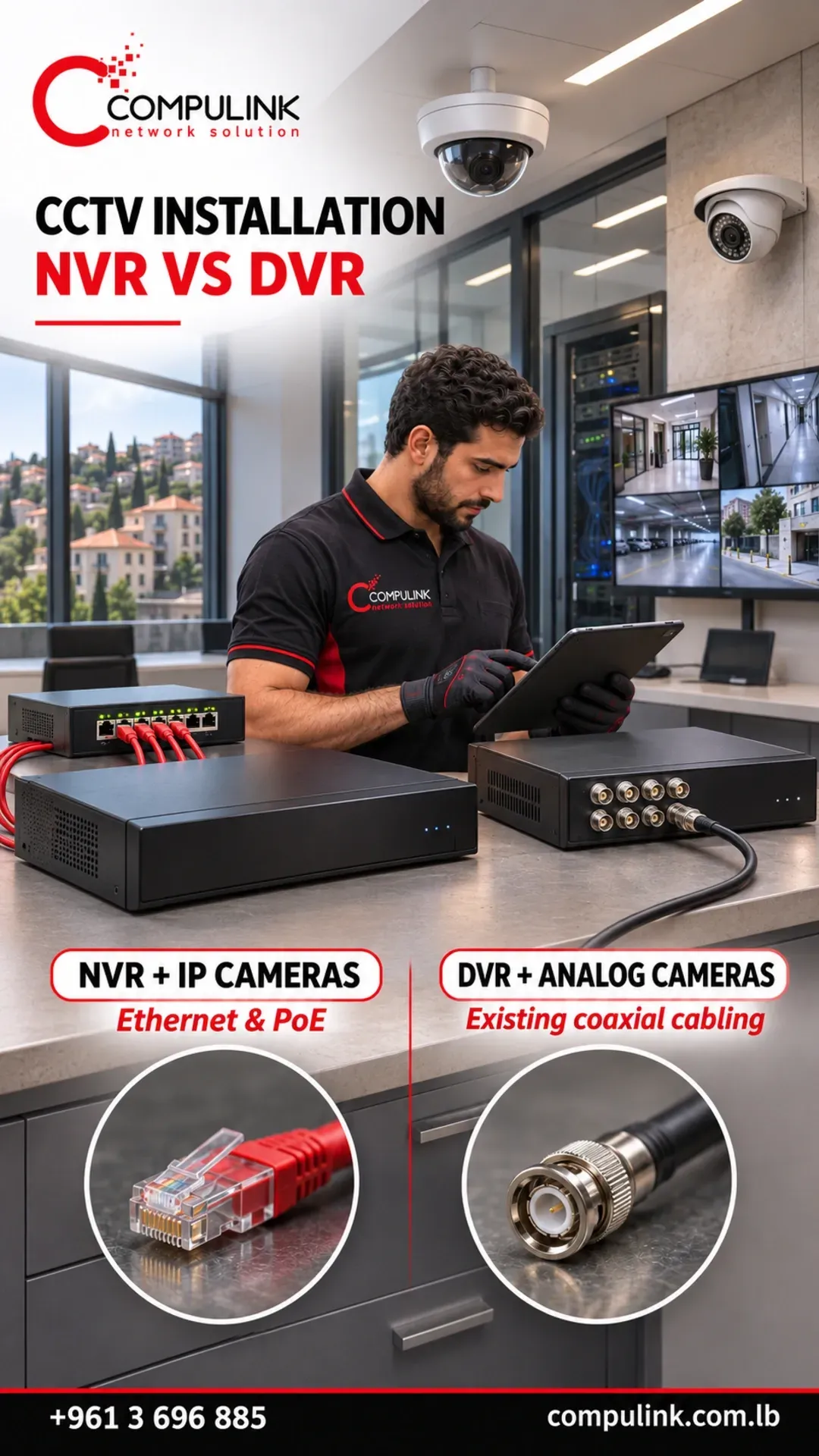
For new CCTV installations in Lebanon, COMPU LINK generally recommends a network video recorder (NVR) paired with IP cameras. Each camera encodes its video and sends it over the network to the recorder. With compatible Power over Ethernet (PoE) equipment, one Ethernet cable carries both data and power to each camera.
Cameras can connect to dedicated switches near their installation areas, giving designers flexibility in cable routing and making it easier to expand coverage. When adding cameras, we check the recorder’s channel count, incoming bandwidth, storage capacity, and switch power budget. Depending on model compatibility, an IP system can also support higher resolutions, camera analytics, audio, and event-based recording.
We can place cameras and the recorder on a separate CCTV network and authorize viewing through a dedicated firewall interface. Storage is sized around recording bitrate, recording schedules, and your required footage retention.
A digital video recorder (DVR) typically receives an analog video signal over coaxial cable and encodes it at the recorder. Conventional DVR layouts bring each camera’s coaxial run back to the recorder and often require separate camera power. A DVR can be a practical choice when existing coaxial cabling is sound, coverage requirements are modest, and reusing the cable avoids reopening finished walls. Some hybrid recorders accept both analog and IP cameras, making a phased upgrade possible.
Before recommending a recorder, COMPU LINK checks cable condition, camera compatibility, expected expansion, and the footage operators need to retrieve.
Ask for the proposed camera count, supported features, and retention estimate in writing so you can compare both designs before committing to an installation.
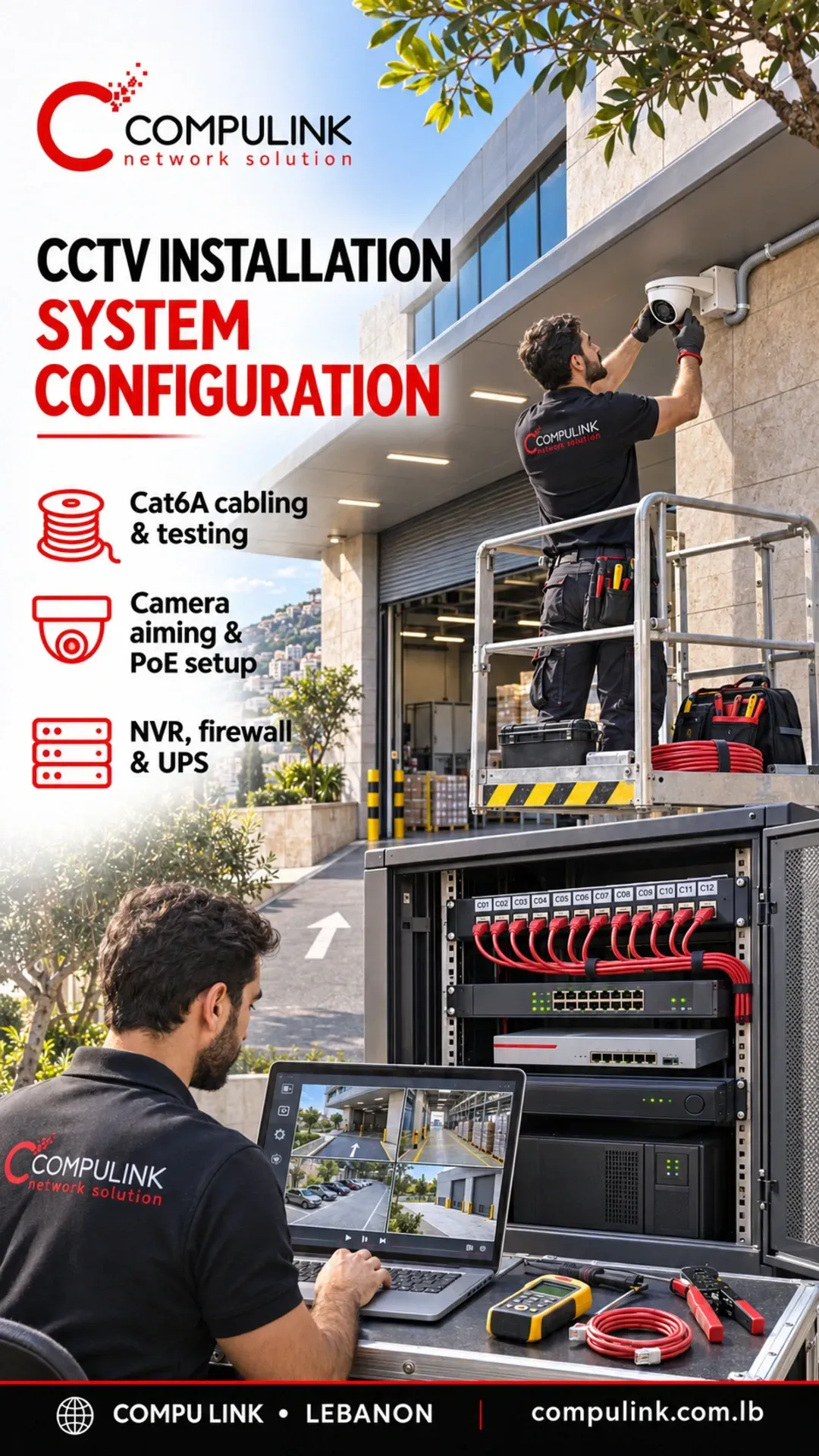
CCTV Installation and System Configuration in Lebanon
COMPU LINK starts installation by confirming the approved camera locations, cable routes, and equipment positions on site. We pull solid-copper Cat6A cabling, terminate each run, and label both ends so your IT team can trace a camera back to its switch port.
We test each completed link before connecting equipment and correct any termination faults while the cable routes are still accessible. We then mount and aim the IP cameras, checking the actual image at each position for obstructions, glare, and the detail needed in the area being monitored.
For outdoor locations, we protect cable entries and connections from weather exposure. We install dedicated CCTV PoE switches and connect them to a dedicated routed firewall interface. We verify that each camera receives the required power and that the switch can support the combined load.
Firewall rules restrict access from other networks and permit approved viewing connections to the recorder. On the NVR, we name camera channels by location, synchronize timestamps, and configure recording schedules, image settings, and user permissions. We verify that footage can be located, played back, and exported using the intended operator account.
We check exported clips independently. Where backup power is included, we size the UPS for the PoE switches, NVR, and any network equipment needed for recording or viewing during an outage.
We confirm which functions the backup design supports and estimate runtime using the connected load. At handover, we provide camera and port labels, document recording settings and access rules, and show your team how to retrieve a clip by camera, date, and time when they need it.

CCTV System Testing and Handover in Lebanon
COMPU LINK tests each CCTV camera against the coverage agreed during the site survey. We review the live view from the operator’s workstation and check that entrances, loading areas, and other priority zones show the detail needed for their intended purpose.
We look for blind spots, glare, and obstructions, then adjust camera angles where needed. We also check low-light performance under representative conditions, including whether infrared reflections from nearby walls or glass obscure important details.
On the NVR, we confirm that each camera channel has a clear location name, the date and time are correct, and recording follows the agreed schedule. Where event-based recording is enabled, we trigger a test event and verify that the recorder saves the expected footage.
We search by camera, date, and time, play back a sample, then export a clip using the intended operator account. We open the exported clip on a separate device and check that it plays correctly and shows the relevant timestamps.
We verify that authorized users can perform their assigned tasks and that guest devices cannot reach the CCTV equipment.
Where UPS backup is included, we test that recording continues during a controlled power interruption.
At handover, your team practices finding an incident, selecting the relevant time range, and exporting a clip.
We provide a camera list, recording settings, and a record of the checks completed.
We record any open items and agreed actions. We also explain how to review the oldest available footage, where to check recorder alerts, and what information to report if a camera goes offline or a recording is missing.

CCTV installation in central Beirut
CCTV installation in central Beirut can involve several different surveillance needs within one business premises. Consider an office with a street entrance, a reception desk, and a separate delivery entrance. The front door needs enough detail to recognize faces, reception needs a view of people moving through the space, and the delivery entrance needs a camera that can handle changing light as the door opens. A COMPU LINK site survey would establish these priorities before equipment is selected.
The survey would also identify where cables can run without disrupting daily operations and which areas should remain outside camera coverage. For new permanent runs, we specify solid-copper Cat6A and size the PoE switches for the maximum camera load.
A dedicated routed interface on the firewall would keep surveillance traffic separate from office and guest networks. Approved staff could reach the recorder without opening access to individual cameras. The NVR storage would be sized around the requested recording period, camera bitrates, and recording schedules.
Before handover, we would check each camera against its intended purpose. At the entrance, that means reviewing faces in recorded footage under representative lighting. At the delivery door, it means checking whether changing light obscures details.
We would also test playback and clip export using the account assigned to the staff member responsible for reviewing incidents.
The handover would include camera labels, recording settings, and instructions for finding footage by camera, date, and time.
These details give the business a clear basis for reviewing the quotation and checking the system after installation. They also help staff retrieve footage when it matters.

CCTV Installation in Lebanon by Industry
CCTV installation in Lebanon by COMPU LINK starts with what your site needs to see, record, and retrieve. For retail stores, supermarkets, and pharmacies, we plan views of entrances, checkouts, aisles, and stockroom doors, accounting for shelving and glare from display lighting.
In offices and commercial buildings, we cover reception areas, shared corridors, parking entrances, and service doors, with footage access assigned to designated staff. For warehouses, logistics centers, and industrial facilities, we assess loading bays, vehicle approaches, dispatch areas, and equipment zones to determine how much detail each camera must capture at the expected distance.
We select lenses for each location. In hotels, restaurants, and other hospitality venues, we plan coverage of public entrances, lobbies, and delivery points while respecting guest privacy. For schools and educational facilities, we agree with the administration on coverage of gates, visitor reception, outdoor circulation routes, and approved common areas.
In hospitals and clinics, we work with facility management to define coverage boundaries around public entrances, reception areas, parking, and delivery routes, and limit who can review footage from those areas.
For residential buildings and compounds, we plan camera views of shared entrances, garage ramps, and common areas while respecting residents’ privacy.
Across these sites, COMPU LINK specifies solid-copper Cat6A cabling, sizes dedicated PoE switches for the camera load, and uses a dedicated routed firewall port to control access to the surveillance network.
We also agree on recording retention and viewing permissions. At handover, your team practices finding footage by camera and time, playing it back, and exporting a clip so they can retrieve recordings when they need them.

CCTV Installation Across Lebanon
CCTV installation in Lebanon by COMPU LINK is available across all eight governorates, from Beirut and its suburbs to the coast, mountains, Bekaa Valley, and southern districts. We cover Beirut, including Achrafieh, Hamra, Verdun, and Downtown.
In Mount Lebanon, we serve Matn (Dekwaneh, Sin El Fil, Jdeideh, Antelias, and Broummana), Baabda (Hazmieh, Hadath, and Baabda), Aley (Aley, Bhamdoun, and Choueifat), and Chouf (Damour, Beiteddine, and Deir El Qamar). In Keserwan–Jbeil, we cover Keserwan (Jounieh, Zouk Mosbeh, Ghazir, and Faraya) and Jbeil (Byblos and Amchit).
In North Lebanon, we serve Tripoli (Tripoli and El Mina), Batroun (Batroun and Chekka), Koura (Amyoun and Kousba), Zgharta (Zgharta and Ehden), Bcharre (Bcharre and the Cedars), and Minieh–Danniyeh (Minieh and Sir El Danniyeh). In Akkar, we serve Halba, Qoubaiyat, and surrounding towns.
In the Bekaa, we cover Zahle (Zahle, Chtaura, and Taalabaya), West Bekaa (Joub Jannine and Qaraoun), and Rashaya (Rashaya and Dahr El Ahmar). In Baalbek–Hermel, we serve Baalbek (Baalbek and Chmistar) and Hermel. In South Lebanon, we cover Saida, Tyre, and Jezzine, including their surrounding towns.
In Nabatieh Governorate, we serve Nabatieh, Bint Jbeil, Marjayoun (including Khiam), and Hasbaya. For each location, we arrange the site survey and plan camera coverage, cabling, PoE switch capacity, and recording retention around the requirements of your property.
When requesting a quotation, share your town, property type, the areas you want to cover, and whether the project is a new installation or an upgrade. For businesses with multiple branches, we review each address and its layout separately, then agree on who should be able to view or retrieve footage.
CCTV Installation in Lebanon FAQs
Do you install CCTV cameras across Lebanon?
Yes. COMPU LINK provides CCTV installation across Lebanon, including Beirut, Mount Lebanon, Keserwan–Jbeil, North Lebanon, Akkar, the Bekaa, Baalbek–Hermel, South Lebanon, and Nabatieh. Share your location and property type so we can arrange a site survey.
How much does CCTV installation cost in Lebanon?
The quotation depends on the number and type of cameras, cable distances, mounting access, PoE switch capacity, and how long you need to retain footage. We confirm the scope after assessing your site so you can see what the quotation covers, including equipment, cabling, installation, and configuration.
Can I choose the camera brand?
Yes. You choose the camera brand. If you already have a preferred manufacturer, we assess suitable models and check compatibility with the recorder and network. If you leave the choice to COMPU LINK, we generally prefer Hikvision IP cameras and recommend models based on your coverage needs and budget.
Can you upgrade an existing CCTV system?
We inspect your existing cameras, cabling, PoE switches, and recorder to determine what can be reused. If you want to add cameras, we check the available ports, switch power budget, recorder capacity, and storage before recommending an upgrade.
Why do you use solid-copper Cat6A cable?
A PoE camera receives power and sends video over the same Ethernet cable. We use solid-copper Cat6A for new permanent camera runs to help limit voltage drop. We also test the completed runs and size the PoE switch for the combined camera load.
Can I view my CCTV cameras remotely?
Yes, if remote viewing is included in your project. We configure approved access to the network video recorder (NVR) and test it at handover. The cameras connect to dedicated PoE switches on a separate firewall interface, so office and guest networks only get the access you approve.
How many days of footage can I keep?
Recording retention depends on the number of cameras, recording bitrate, recording schedule, and usable storage. Tell us how many days you need, and we’ll size the NVR storage around that target and document the assumptions in the proposal.
Will the cameras keep recording during a power outage?
They can if the project includes a correctly sized UPS for the PoE switches, NVR, and any other equipment required to keep recording. We estimate runtime based on the connected load and verify recording during a controlled power interruption when backup power is included.
What do you test before handing over the system?
We check camera coverage, low-light performance, recording, playback, footage export, and user permissions. Your team practices finding a recording by camera, date, and time, then exporting a clip.
How do I request a CCTV site survey?
Send COMPU LINK your town, property type, priority areas, and whether you need a new installation or an upgrade. If you already know how many days of footage you want to keep, include that too. WhatsApp COMPU LINK at +961 3 696 885