
IT Network Infrastructure Installation for Construction Sites in the USA
Compulink provides network infrastructure installation, configuration, and testing for construction sites, data centers, and site offices across the USA. Project assignments can include on-site technical work and coordination with local teams.
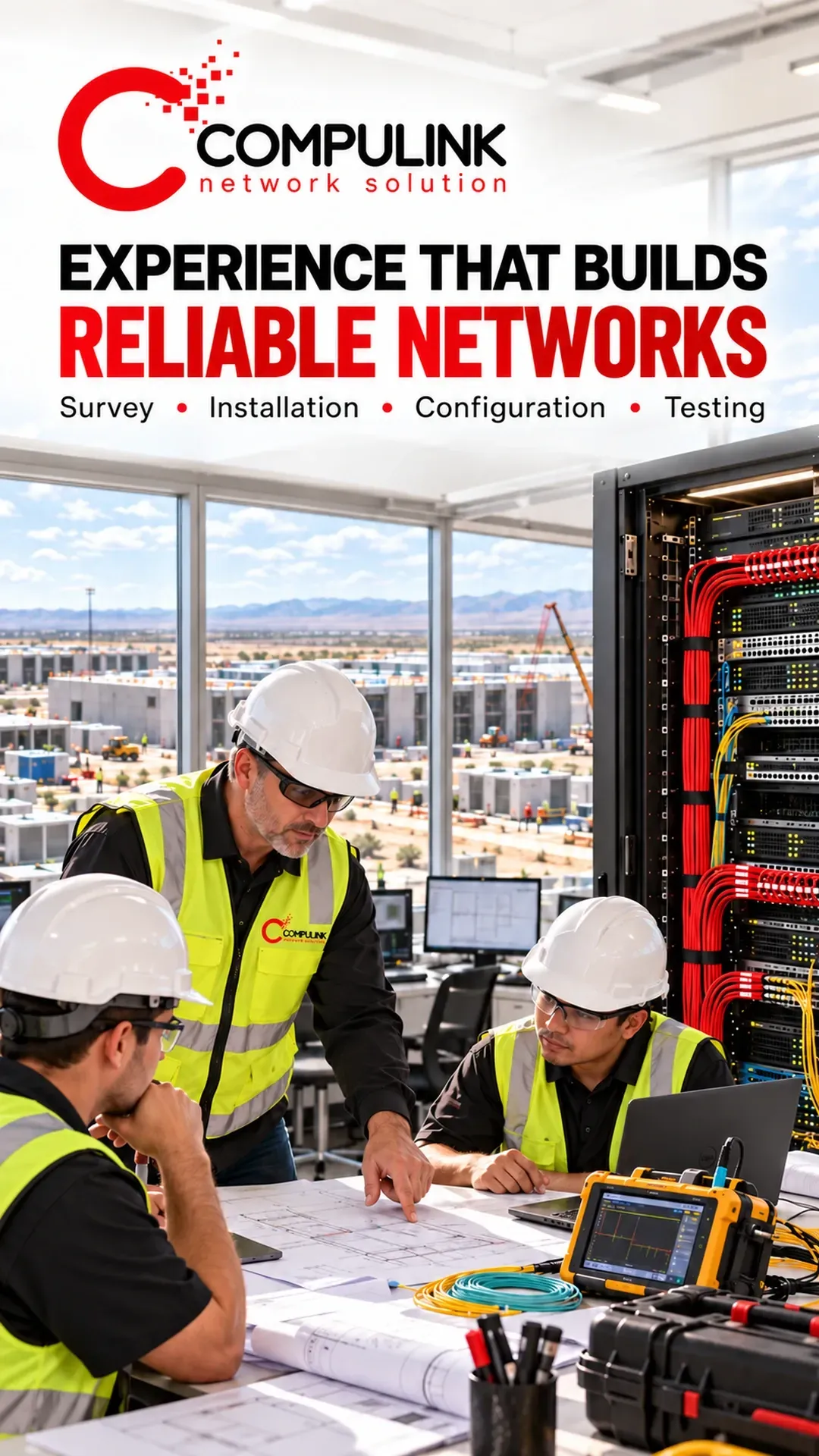
Construction projects depend on network infrastructure long before the buildings are complete. Engineers need reliable connectivity in site offices, contractors need access to drawings and project systems, and the finished facility needs a network that performs as designed. Compulink provides professional IT network infrastructure installation, configuration, and testing for construction sites, data centers, and site offices in the USA.
Led by Fadi Helou, Network Infrastructure Specialist, Compulink brings more than 33 years of hands-on experience in network design, structured cabling, equipment installation, wireless connectivity, and network security. That knowledge is applied to the actual conditions on site: reviewing drawings, inspecting existing pathways and cabinets, identifying technical conflicts, and defining the work required before installation begins.
During execution, we coordinate with the client’s engineers, construction management, and local contractors. We oversee cable routes and terminations, install and configure network equipment within the agreed scope, check fiber and connectivity requirements against project specifications, and test the completed systems. Issues are identified early, documented clearly, and resolved with the responsible teams before they delay the next stage of work.
The benefit to the client is practical: fewer assumptions, less rework, clearer coordination, and a network ready for the people and systems that depend on it. For short assignments or longer project phases, Compulink brings experienced on-site direction and focused technical execution to each network infrastructure project, from initial site setup through final commissioning.
We adapt the network plan as construction phases, site access, and equipment requirements change. Each installation is checked against the approved drawings and the conditions found on site.
Clear test results give project teams confidence before the network is put into use. The result is infrastructure built around the project’s schedule and its long-term operational needs.

IT Network Infrastructure Site Survey & Design Review
Network Site Survey, Drawings & Construction Readiness
An IT network infrastructure project can lose time when construction drawings no longer reflect conditions on site. Cabinet positions may have changed, pathways may still be incomplete, or another trade may occupy a planned cable route. Before installation begins, the client needs a clear view of the conditions, the design, and any decisions that could affect the work.
Compulink performs an on-site network survey and reviews the drawings, project scope, and construction progress for the assigned areas.
We examine cabinet and equipment locations, fiber and cable pathways, site office requirements, connectivity, and coordination points with power and other building systems.
We compare planned routes and equipment locations with what has been built, then document conflicts, missing information, and items requiring confirmation from the designer or project team.
When site conditions call for a change, we identify the issue and coordinate the review before the affected installation moves forward.
This process gives the client a record of site readiness and a clear list of actions for the teams. It also helps align network installation with the construction schedule, reduce avoidable rework, and keep each task moving toward testing and handover.
For projects with several contractors or changing site conditions, that visibility helps managers plan materials, access, and work sequences with confidence.The result is a network scope that can be installed against verified conditions rather than assumptions carried forward from drawings.
IT Network Infrastructure Planning for Construction Projects
Network Installation Planning and Construction Scheduling
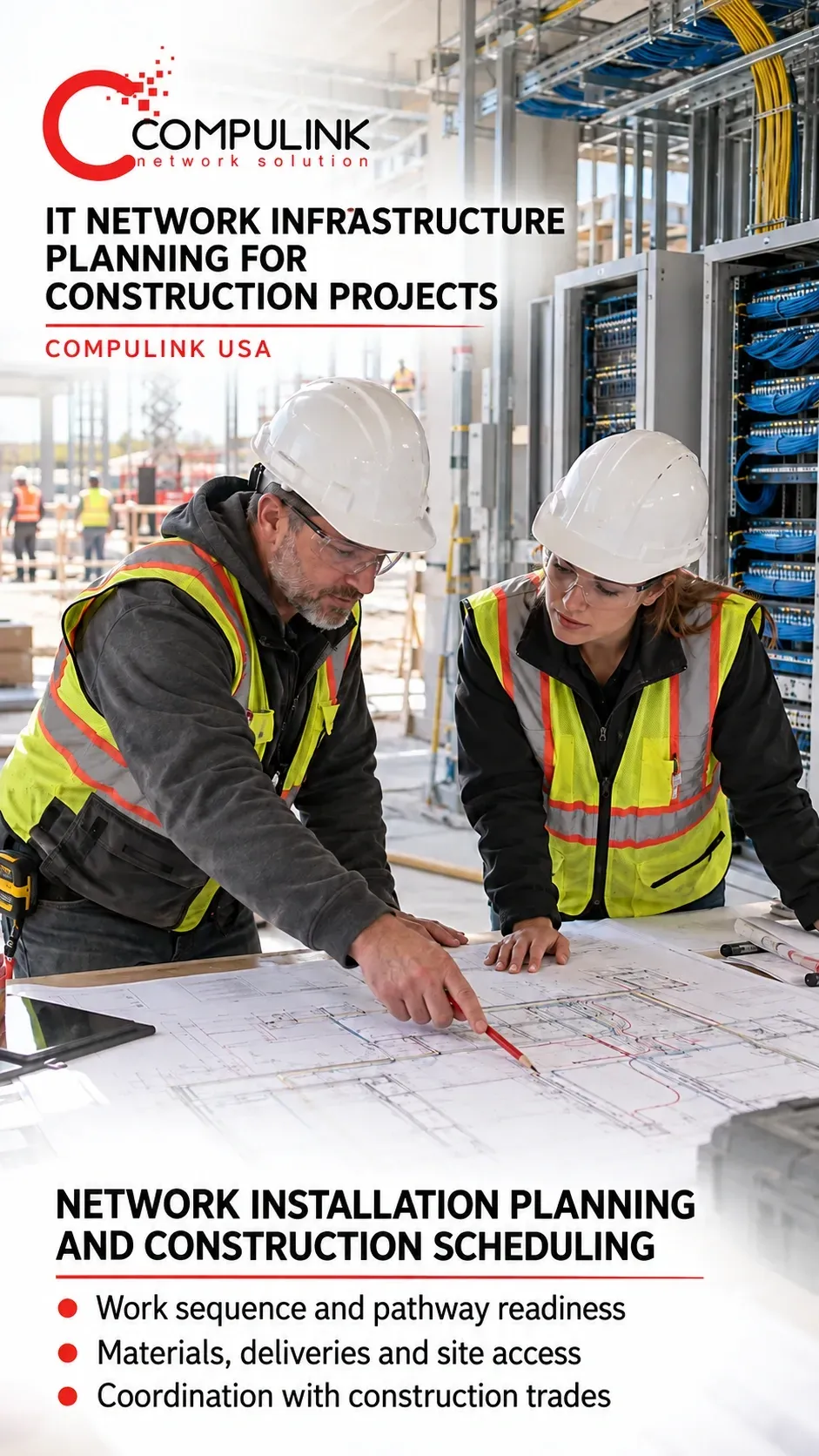
Construction projects change as work progresses. Cable pathways may open later than planned, equipment rooms may not be ready, and several trades may need access to the same areas. Without a coordinated network plan, materials can arrive too early, installation teams can lose time, and decisions can delay the next construction phase.
Compulink reviews the assigned network scope, drawings, survey findings, and project schedule to build a practical installation plan. We identify the required fiber, cabling, cabinets, switches, and materials for each stage.
We organize work sequences around site access, pathway readiness, equipment delivery, and dependencies on power or other trades. Where the project includes temporary site offices, we plan their connectivity so construction teams can work while infrastructure is being built.
As conditions change, Compulink tracks network issues, reviews their impact on the scope, and coordinates decisions with the client, designer, construction manager, and contractors.
We document what can proceed, what requires clarification, and which activities must wait for another task to finish. This helps avoid sending technicians into unfinished areas or installing equipment before its location and connections are confirmed.
The client gains a clearer sequence for network work, material and access requirements, and better visibility into decisions that affect progress.Each planned stage can move toward installation, testing, and handover with fewer interruptions, while the network team stays aligned with the construction schedule and the project requirements..
Fiber Optic and Structured Cabling Installation
Fiber Optic Routes, Cable Termination and Testing
Construction projects depend on reliable cabling to connect equipment rooms, site offices, wireless systems, and other network endpoints. When pathways are incomplete, fiber routes conflict with other trades, or cables are poorly labeled, installation can stall and faults become harder to trace. The client needs cabling that follows the design and remains practical to maintain.
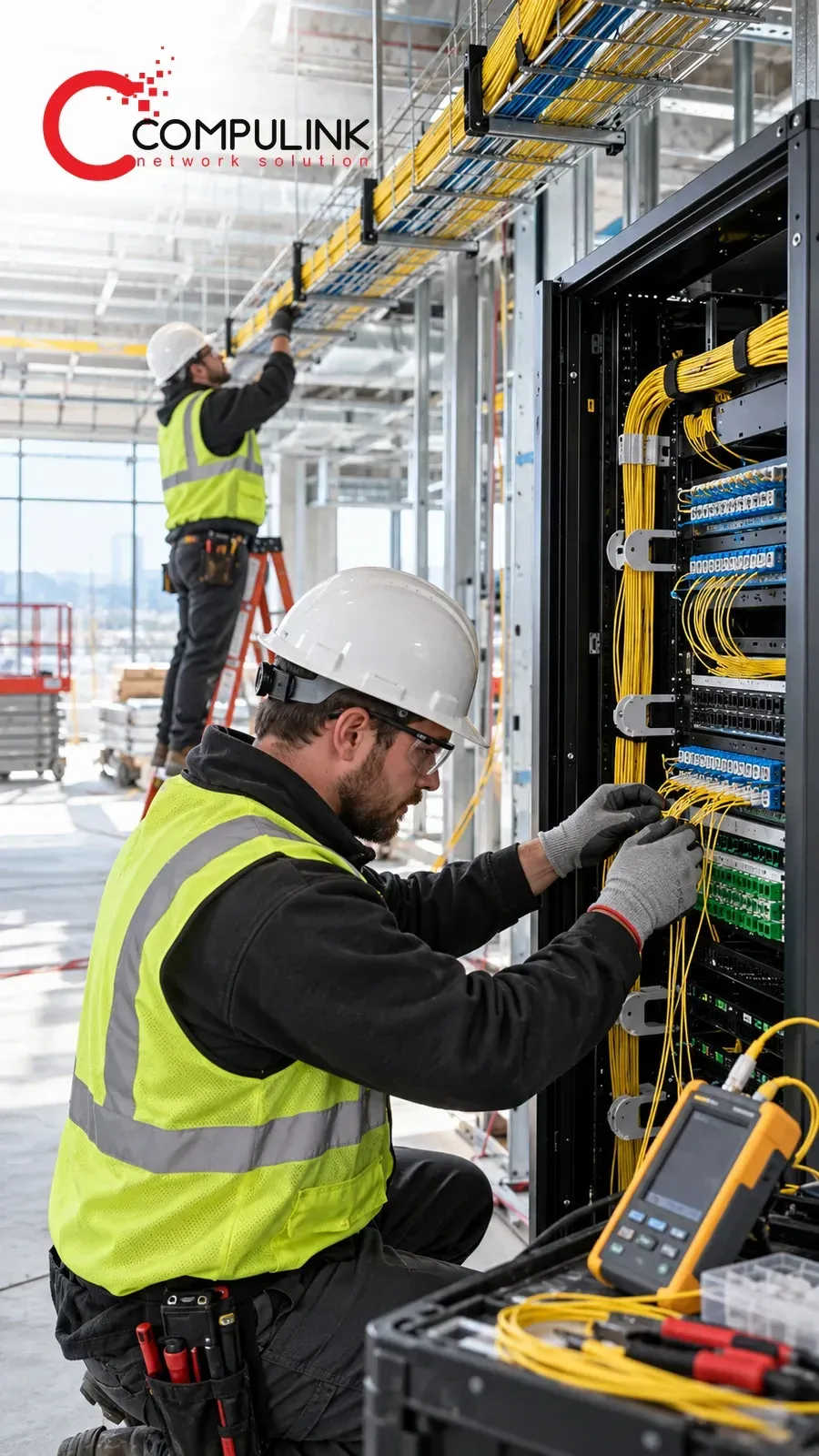
Compulink installs fiber optic and structured cabling within the assigned network scope and approved drawings. We coordinate routes and access with the construction team, check pathway readiness, and plan cable pulls around other site activities. Our work includes cable placement, termination, patching, identification, and organized connections at the cabinets and equipment locations. We document route changes and unresolved conflicts for review before affected work continues.
For data center environments, we follow the specified fiber architecture and the project's required link capacity, including high-speed connections where designed. For site offices and supporting systems, we install the cable types and connections stated in the project documents. Each environment receives the infrastructure its design requires, with clear separation between temporary construction connectivity and permanent network installation.
After installation, Compulink tests the assigned links, records results, identifies faults, and corrects installation issues within our scope.
The client gains traceable connections, records for the project team, and a dependable foundation for switch installation and network configuration.Verified cabling also reduces troubleshooting during commissioning and makes future changes easier to manage.

Network Switches, Cabinets & Equipment Installation
Network Switch Installation, Cabinet Layout and Equipment Patching
A network cabinet can become a delay when equipment positions, power needs, and cable entries are decided too late. Crowded racks, unclear patching, and missing labels make installation difficult and leave the project team with faults that take longer to locate. Clients need cabinets and switches installed in a clear, serviceable arrangement.
Compulink reviews the approved drawings, cabinet schedules, equipment list, and site conditions before installation. We confirm cabinet placement, space, pathway entries, power coordination, and the sequence for mounting network equipment. Within the assigned scope, we install cabinets, mount switches and devices, organize patch panels and connections, and route patch cords so ports remain accessible for testing and maintenance. Equipment positions and cable identifiers are recorded as work progresses.
For projects with multiple network segments, we follow the specified architecture and keep connections organized by system and purpose. We coordinate equipment installation with fiber and cabling teams, electrical contractors, and other trades where their work affects the cabinet. Any missing equipment, conflicting locations, or design changes are documented for the project team before the affected connections are completed.
The client receives a cabinet installation that supports network configuration and makes testing more efficient.
Clear patching and documentation help technicians trace connections, resolve issues, and hand over an understandable system.As construction advances, organized cabinets also make it easier to add approved equipment or adapt connections without disturbing completed work.

Network Configuration, Connectivity & Security
Network Switch Configuration, Firewall Segmentation and Wi-Fi Coverage
Installed switches and cables do not give teams a usable network until devices are configured and connections are verified. Unplanned access between systems, weak wireless coverage, or unclear settings can interrupt site operations and complicate handover. The client needs connectivity that follows the approved design and gives each team access to the resources it requires.
Compulink configures network switches, equipment, and wireless access points within the assigned project scope. We apply the agreed addressing, port settings, access rules, and network security controls, then check communication between approved devices and services.
Where the design calls for separate network segments, we implement the specified switch and firewall arrangements and verify that traffic follows the intended paths. Wireless access points are placed and configured according to site conditions, coverage needs, and the installation plan.
During construction, site offices and permanent systems may come online in stages. Compulink coordinates these changes with the project team, records configuration details, and checks connections when equipment or routes are added.
If a requested connection conflicts with the approved scope or security rules, we identify it for review before making a change. The client gains a working network with documented settings, controlled connectivity, and clear responsibilities for each project phase.
Testing helps expose configuration errors early, while organized records make troubleshooting and future changes easier.The result supports site work and prepares the infrastructure for commissioning and handover.
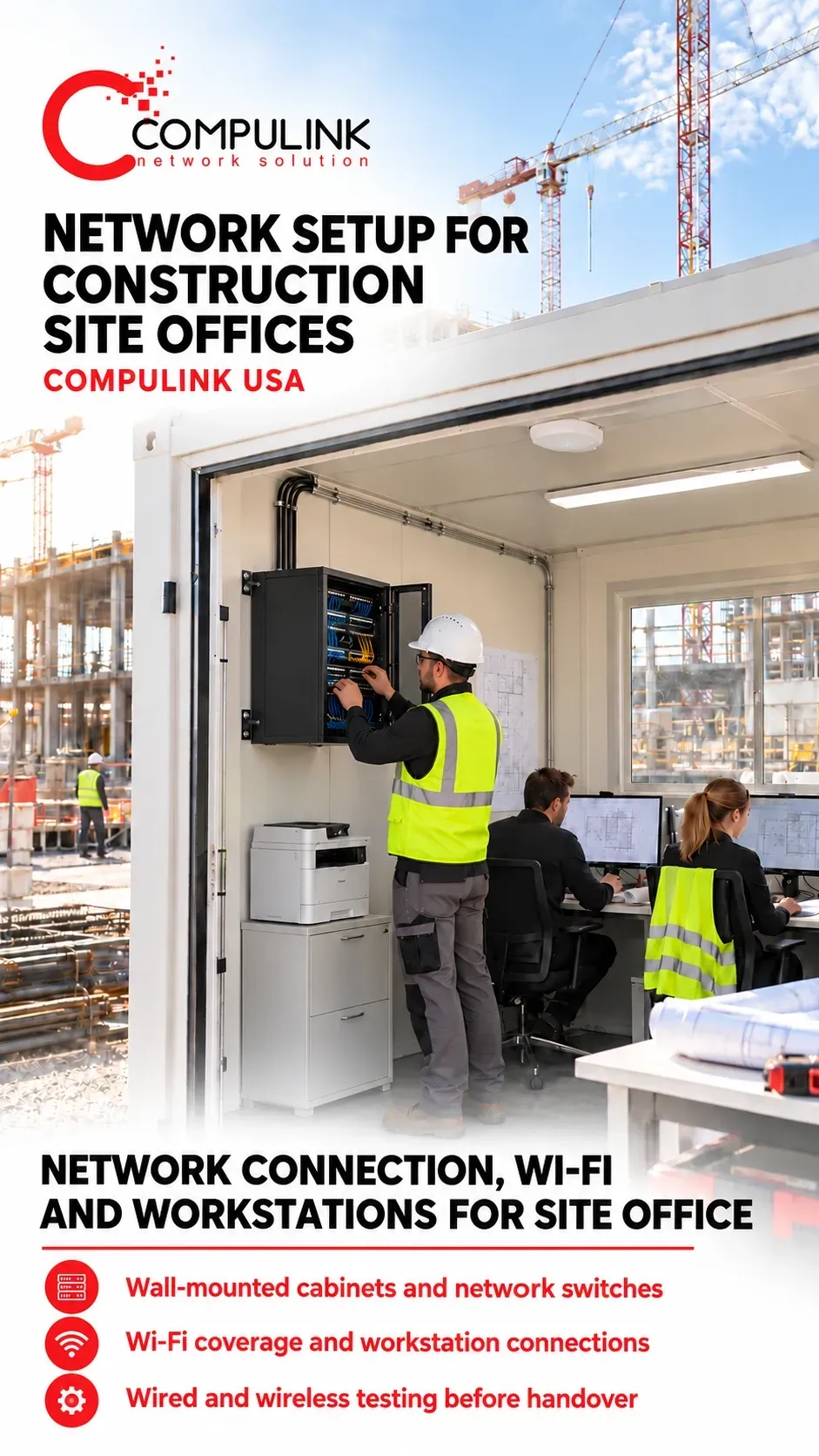
Network Setup for Construction Site Offices
Network Connection, Wi-Fi and Workstations for Site Office
Construction site offices need dependable connectivity before building systems are ready. Engineers, managers, and contractors rely on access to drawings, schedules, email, printers, and project resources. An office with unstable Wi-Fi, poorly placed equipment, or unclear cabling can slow decisions across the site.
Compulink sets up the assigned network infrastructure for construction site offices, including portable buildings and container offices. We review the office layout, users, available internet connection, power, and the equipment specified for the assignment. We install and configure network cabinets or wall-mounted equipment, switches, structured cabling, wireless access points, and connections for workstations, printers, and communication devices. Wireless placement considers both coverage and the number of users working in each area.
Where the office network must reach approved project systems, Compulink configures connectivity and security controls according to the agreed design. We coordinate with the client's internet provider and site team for service availability, cable routes, access, and installation timing.
If the office moves or expands during construction, we document what needs to be relocated or added and review the changes with the project team.The client gains a practical working environment for daily construction operations, with clearer connections and fewer avoidable interruptions. We test wired and wireless access, record the configuration, and explain the installed network at handover. The setup can support the project team while construction progresses and provide an orderly path for later changes.

Network Testing, Issue Resolution & Commissioning
Network Link Testing, Fault Correction and Commissioning Records
A network can appear complete while hidden faults remain in fiber links, switch ports, configuration, or wireless coverage. If these problems surface after teams begin using the system, they can disrupt construction operations and delay handover. The client needs test results that show what works, what failed, and what still requires action.
Compulink tests the network infrastructure within the assigned scope against the design and project requirements. We check fiber and cabling links, switch connectivity, device communication, wireless coverage where included, and access between approved systems. We record results, identify faults, and separate installation issues from items that require a design decision or work by another trade. Our team corrects issues within its responsibility, then repeats the relevant checks to confirm the result.
Testing follows the project’s construction sequence. A site office may need to operate while permanent network areas are still being installed, so we verify each area when it is ready rather than assuming the entire site is complete.
We coordinate unresolved items with the client, designer, construction manager, and contractors, and track the actions needed before commissioning.
The client receives clear evidence of network readiness, a record of corrected issues, and visibility into any remaining exceptions. Before handover, Compulink reviews the agreed test records and configuration documentation with the project team.
This process supports reliable operation, more efficient troubleshooting, and an orderly transition from installation to use.

Network Infrastructure On-Site Project Leadership
Network Infrastructure Site Leadership and Contractor Coordination
Large construction projects can have capable installers yet still lose time when network responsibilities, drawings, and work sequences are not coordinated on site. A cabinet may be ready while its fiber route is blocked, or a design question may remain unanswered as contractors move to the next area. The client needs experienced technical direction within a clearly agreed network scope.
Fadi Helou, Network Infrastructure Specialist, leads Compulink’s on-site network assignments. He reviews the drawings and site conditions with the project team, confirms installation priorities, coordinates network contractors and other trades, and follows technical issues through to a documented decision.
He checks that materials, cabinet locations, cable pathways, equipment installation, and testing activities match the approved plan. Where a proposed change affects the design, he raises it with the responsible designer and client before implementation.
Compulink can take on a focused assignment to survey a site, review installation progress, resolve a defined issue, or supervise a specific phase. Longer assignments can cover planning, contractor coordination, installation oversight, testing, and handover as the project advances.
The duration, travel arrangements, local team roles, and authority to make decisions are agreed before work begins.
The client gains a visible point of coordination for the network scope and clearer records of what is complete, blocked, or awaiting approval.
Site checks and communication help teams address problems early and keep network work aligned with construction milestones.

IT Network Infrastructure Industry Targeting in the USA
Network Infrastructure for Data Centers, Construction Campuses, Site Offices and Industrial Facilities
Every construction environment has its own network challenge. A data center depends on planned fiber routes and high-capacity links. A construction campus needs site offices connected while buildings are taking shape. Industrial and utility sites bring long pathways, controlled access, and several trades working in the same areas. Compulink builds each assignment around those conditions.
Across the USA, Compulink targets network infrastructure work for data centers, cloud facilities, construction campuses, site offices, industrial plants, and energy or utility projects. We review drawings, site readiness, schedules, and the client’s priorities before defining our scope. Compulink can perform fiber and structured cabling installation, cabinet and switch installation, site office connectivity, network configuration, testing, and coordination of the assigned network work. The equipment and link capacities follow the approved project design and the requirements of the facility.
For a data center, that may mean installing and testing specified high-speed fiber links. For a construction campus, it may mean bringing a site office online first, then coordinating network areas as the build progresses. For an industrial or utility site, the work must fit its access rules, safety procedures, and operating systems.Clients gain a network infrastructure specialist who understands how installation fits the construction schedule.
Compulink can take responsibility for a defined technical phase or work on site for a longer assignment, coordinating with the designer, construction manager, and contractors through testing and handover.
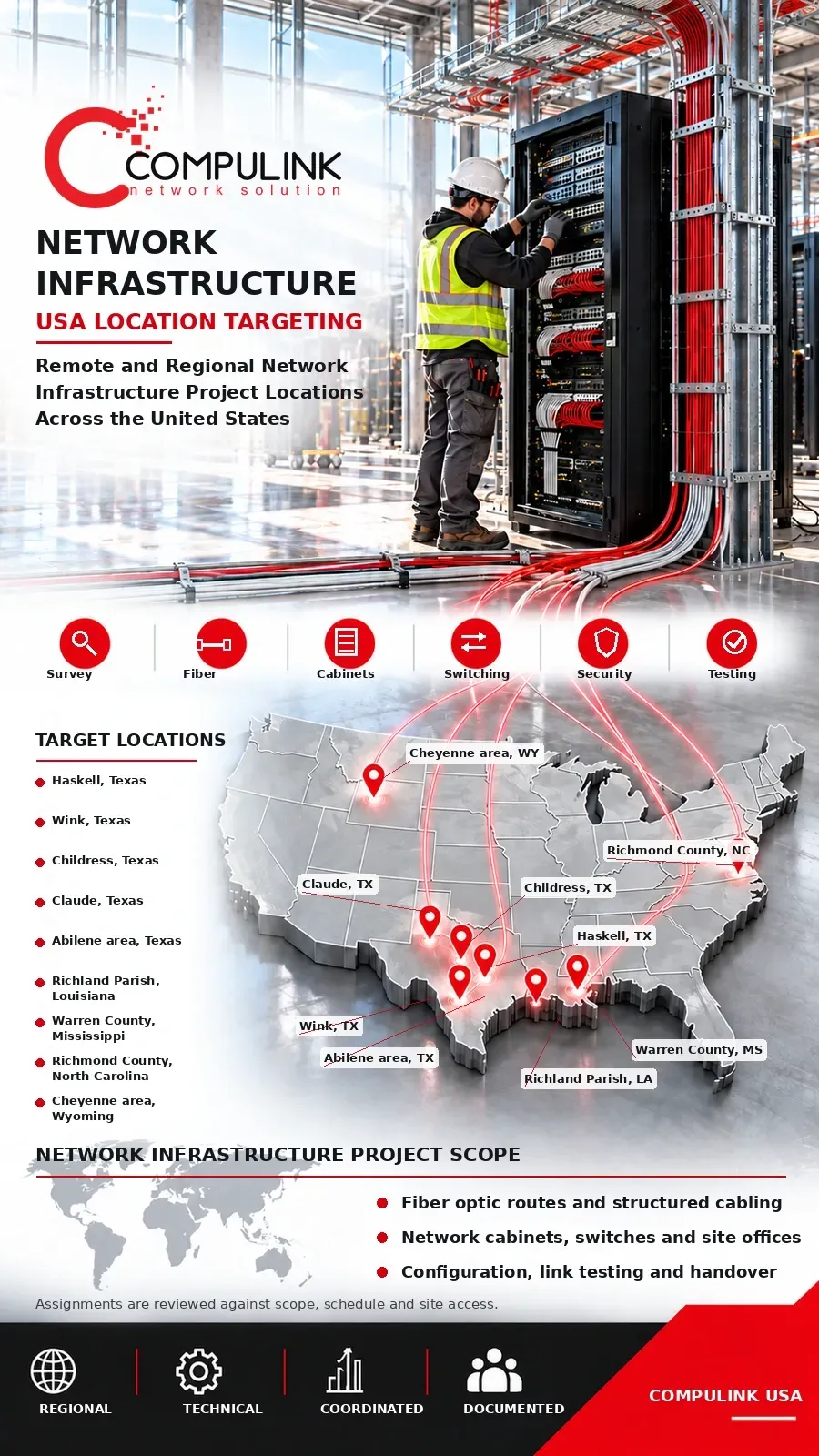
IT Network Infrastructure Location Targeting Across the USA
Remote and Regional Network Infrastructure Project Locations Across the United States
Remote construction and data center projects need network infrastructure teams that can work to approved drawings, coordinate with other trades, and verify completed links. Compulink targets assignments across United States locations. Our first research priorities are Haskell, Wink, and Childress in Texas; Richland Parish in Louisiana; and Warren County in Mississippi.
In Texas, Compulink also targets Claude in the Texas Panhandle and the Abilene area, a regional construction hub. Additional target areas are the Vicksburg area of Warren County, Mississippi; Richmond County, North Carolina; and sites in the Cheyenne area of Wyoming. These names identify places where we seek opportunities. They do not imply an existing Compulink office, crew, client, or completed project in any location.
Compulink performs fiber optic and structured cabling installation, cabinet and switch installation, site office connectivity, network configuration, testing, and documentation within an agreed scope.
A project may require phased installation as buildings become ready, temporary connections for construction offices, or permanent links specified for a data center. We review drawings, access rules, schedule, travel arrangements, and technical requirements before accepting an assignment.
Clients gain a responsible network infrastructure specialist who coordinates the assigned work with the construction manager, designer, and other trades.Compulink records route conflicts and installation changes, checks completed connections, and provides test results for commissioning and handover.
We expand our location targets as relevant projects and network infrastructure needs are verified.

Arrange a Compulink Network Infrastructure Assignment in the USA
Project Enquiry, Scope Review and On-Site Mobilization
Contact Compulink with your project location, required network work, expected dates, and available drawings. We review the technical scope, site readiness, schedule, and staffing needs with your project team, then agree on responsibilities, deliverables, and the arrangements required for the assignment.
Fadi Helou, Network Infrastructure Specialist, can travel individually for site surveys, technical reviews, installation oversight, contractor coordination, testing, or project leadership. Clients can engage Fadi to lead their existing technicians and contractors.
Where additional personnel are needed, he can help select and coordinate locally based technicians or subcontractors, subject to the client’s approval and project requirements. Bringing a Compulink team is optional, allowing staffing and travel costs to match the assignment.
Fadi is comfortable communicating and working in English and enjoys collaborative, multinational project environments. His experience in Dubai includes working extensively with American, British, Australian, Indian, and Pakistani colleagues and crews. He brings that experience to technical discussions, team coordination, and daily site work.
Before mobilization, we agree on fees, assignment duration, travel, accommodation, site access, and team responsibilities. Required work authorization and site onboarding must also be confirmed before on-site work begins. Whether you need one specialist to lead an established team or coordination of a locally assembled crew, Compulink structures the assignment around your project’s needs.
IT Network Infrastructure USA — Frequently Asked Questions
What network infrastructure services does Compulink provide for construction projects?
Compulink provides site surveys, drawing reviews, installation planning, fiber optic and structured cabling installation, cabinet and switch installation, network configuration, testing, and handover documentation. Each assignment follows an agreed scope and the approved project requirements.
What types of projects does Compulink target in the USA?
Compulink targets data centers, cloud facilities, construction campuses, site offices, industrial plants, and energy or utility projects. Assignments can cover a defined technical phase or longer on-site network infrastructure leadership.
Which USA locations does Compulink target?
Our target locations include Haskell, Wink, Childress, Claude, and the Abilene area in Texas; Richland Parish, Louisiana; Warren County and the Vicksburg area, Mississippi; Richmond County, North Carolina; and sites around Cheyenne, Wyoming. These are opportunity targets, rather than claims of existing Compulink offices or completed projects.
Can we engage Fadi individually without bringing a Compulink team?
Yes. Fadi Helou, Network Infrastructure Specialist, can travel individually for surveys, technical reviews, installation oversight, contractor coordination, testing, or project leadership. Clients can engage him to lead their existing team. Bringing a Compulink crew is optional.
Can Fadi lead our existing technicians and contractors?
Yes. Fadi can lead the assigned network work with your on-site technicians and contractors, reviewing priorities, coordinating work sequences, checking progress, and tracking technical issues. His responsibilities and decision-making authority are agreed before the assignment begins.
Can Fadi coordinate a newly assembled local team?
Yes. Fadi is comfortable working with a new local team. Where additional personnel are needed, he can help select and coordinate locally based technicians or subcontractors, subject to client approval and project requirements.
Is Fadi comfortable working in English with multinational teams?
Yes. Fadi communicates comfortably in English and enjoys collaborative, multinational environments. His experience includes working with American, British, Canadian, Australian, Indian, Pakistani, and Filipino colleagues and crews, including extensive collaboration in Dubai.
Does Compulink accept short assignments?
Yes. Short assignments can cover a site survey, drawing review, progress inspection, defined technical issue, or specific installation phase. The scope, deliverables, dates, and fees are agreed before work begins.
Can Fadi stay for a longer project phase or extend an assignment?
Yes. Fadi is open to longer assignments and extensions, subject to availability and agreement on the additional work, fees, accommodation, and travel arrangements. Required work authorization must cover the assignment and any extension.
Does Compulink require travel and relocation support?
Yes. For an assignment requiring travel to the USA, the client must cover airfare and agreed travel or relocation expenses. Departure and return travel arrangements are confirmed before mobilization, together with the assignment duration and commercial terms.
Is client-funded housing required?
Yes. Client-funded housing is required, with suitable accommodation arranged and paid for at least the first month before arrival. Housing for any remaining assignment period must also be agreed before work begins.
What should we send when requesting an assignment?
Send the project location, required services, expected dates, available drawings, equipment requirements, and current construction status. Include details of your existing team, site access, and any known installation issues so Compulink can review the assignment.
What must be confirmed before Fadi travels to the USA?
The client and Compulink must confirm the scope, deliverables, fees, duration, airfare, housing, site access, and team responsibilities. Required work authorization and site onboarding must be in place before on-site work begins.
Can Compulink set up a construction site office before permanent systems are ready?
Yes. Compulink installs and configures site office connectivity, including switches, cabling, wireless access points, and workstation or printer connections within the agreed scope. Temporary office connectivity is planned separately from permanent network installation.
Does Compulink follow the project’s specified fiber architecture and equipment requirements?
Yes. Fiber architecture, cable types, equipment, and link capacities follow the approved project design. Compulink reviews discrepancies with the responsible designer and client before implementing affected changes.
How are network faults handled before commissioning?
Compulink records test results, identifies faults, corrects issues within its responsibility, and repeats the relevant checks.
Items requiring a design decision or another contractor’s work are documented and coordinated with the project team.
What documentation does Compulink provide at handover?
Depending on the agreed scope, handover records include link test results, equipment and cable identification, configuration details, installation changes, and outstanding issues. These records help the project team understand network readiness and maintain the installed systems.