
Network Services in Lebanon & Worldwide | Compulink
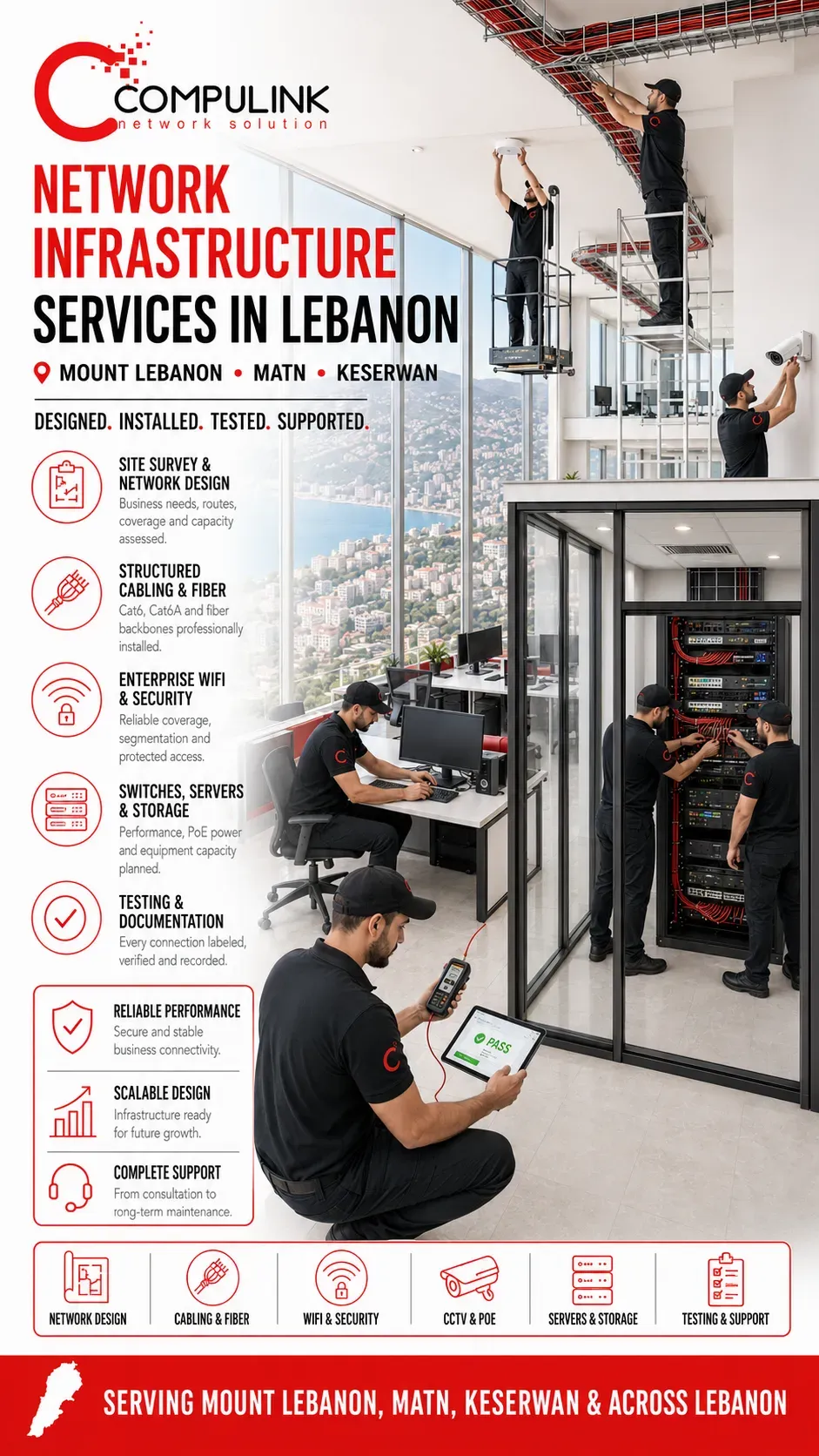
Network Infrastructure Services give businesses the fast, stable, secure, and scalable connectivity they need to operate without interruption. Compulink provides professional network infrastructure design, installation, configuration, security, and technical support for offices, hotels, schools, healthcare facilities, retail businesses, warehouses, industrial sites, and commercial organizations of every size.
Our strongest service coverage extends across Lebanon, with particular focus on Beirut, Mount Lebanon, Matn, and Keserwan. We also provide professional IT Network Services for businesses throughout the GCC, Europe, the United Kingdom, the United States, Canada, Australia, and other international markets, delivering expert Network Infrastructure Design, Fiber Optic Solutions, Enterprise WiFi, Network Security, Structured Cabling, Servers & Storage, Data Infrastructure, Managed IT Services, CCTV Systems, and Access Control Systems.
Compulink delivers complete business network solutions, including network planning, Cat6 and Cat6A structured cabling, fiber optic backbones, network cabinets, patch panels, managed switches, enterprise WiFi, network security, servers, storage, backup systems, testing, documentation, and ongoing IT support. Every installation is professionally engineered around your building, users, connected devices, security requirements, and future expansion plans.
Whether you are opening a new office, upgrading an outdated network, expanding to additional floors, or connecting multiple business locations, Compulink builds a dependable infrastructure that improves performance, protects critical data, reduces connectivity problems, and keeps your organization ready for future growth.
Every project begins with a detailed network site survey and infrastructure assessment.
Our experienced technicians follow professional installation standards to ensure that every network cabinet, data outlet, patch panel, switch, WiFi access point, CCTV camera, server, and workstation is correctly installed and configured.
After installation, Compulink performs complete
network testing, cable labeling, performance verification, troubleshooting, and technical documentation to deliver an organized and dependable business network.

Network Infrastructure Problems After Installation: Why Do They Appear?
Network infrastructure problems after installation often begin several months after a project is completed. The network may initially appear stable because only a limited number of users, computers, CCTV cameras and WiFi devices are connected. As business activity increases and more equipment is introduced, weaknesses hidden inside the original design begin affecting network speed, stability and security.
Network design gaps are one of the main reasons these problems appear. Infrastructure must be planned according to business applications, data traffic, connected systems, operating hours, security requirements and future expansion. A network designed only for the company’s current needs may become overloaded when new employees, WiFi access points, CCTV cameras, IP phones, servers or storage systems are added.
Structured cabling failures can also remain hidden during the initial handover. Unsuitable cable categories, poor-quality conductors, excessive cable distances, incorrect termination, damaged cable pairs and badly planned pathways may still produce a basic connection. However, these weaknesses become visible under higher bandwidth or PoE demand, causing unstable network points, reduced performance and intermittent disconnections.
PoE power planning, network switch capacity and uplink performance must be calculated as one connected system. A switch may provide enough physical ports while lacking the total PoE power budget or traffic capacity required by WiFi access points, CCTV cameras and connected devices. Firewall performance and network segmentation must also be planned according to actual traffic and security requirements.
Network testing and certification identify installation defects before the infrastructure becomes responsible for daily business operations. Compulink verifies
structured cabling, PoE delivery, switch connectivity, network performance, cabinet organization and technical documentation before final handover.

Network Site Survey and Business Discovery Meeting
A professional network site survey begins with understanding the business before selecting cables, switches, WiFi access points or network cabinets. Compulink meets with management to identify critical systems, operational requirements and what the infrastructure must support now and in the future.
The business discovery meeting evaluates employees, connected devices, applications, cloud services, servers, storage, CCTV cameras, access control, IP phones and guest WiFi. We also discuss data sensitivity, remote access, expected expansion and the business impact of network downtime.
The physical infrastructure assessment reviews floor plans, cable pathways, installation distances, electrical interference, containment, cabinet locations, power, UPS protection, ventilation and maintenance accessibility. Compulink evaluates suitable positions for WiFi access points, CCTV cameras, network switches, fiber optic backbones and structured cabling routes.
The completed Compulink assessment defines cabling requirements, fiber backbones, cabinet capacity, switch performance, PoE power, WiFi coverage, firewall architecture, network segmentation, testing procedures and future expansion. This methodical process reduces installation risks, costly design changes and infrastructure rebuilding.
Compulink provides Network Site Surveys and Business Infrastructure Assessments across Lebanon, the GCC, Europe, the United Kingdom, the United States, Canada, Australia, and Worldwide.
Compulink conducts professional network site surveys across Lebanon, assessing cabling, fiber, WiFi, CCTV, PoE, security, capacity and future expansion before designing reliable business infrastructure.
Every
Network Design recommendation reflects real
Business Requirements, ensuring
Scalable,
Secure, and
High-Performance Network Infrastructure.
Our engineering approach improves
Network Reliability, simplifies future expansion, strengthens
Network Security, reduces operational risks and maintenance costs, and delivers long-term business growth with maximum efficiency, stability, and performance.

Network Capacity Planning, Traffic Management and Segmentation
Network capacity planning determines whether an infrastructure can support current users, business applications and connected systems without creating performance bottlenecks. Compulink evaluates computers, servers, storage, cloud services, CCTV cameras, WiFi access points, IP phones and future expansion before defining switching, uplink and backbone requirements.
Business traffic analysis studies where data is generated, where it must travel and which applications require priority. Large file transfers, centralized storage, cloud platforms, video surveillance and internet traffic can create very different demands. Compulink plans the complete traffic path instead of considering each device separately.
Network traffic management helps prevent one application or system from consuming resources required by critical operations. Switch capacity, uplink speed, internal bandwidth and firewall performance must work together to maintain reliable connectivity during normal and peak business activity.
Network segmentation separates users, servers, CCTV systems, guest WiFi, access control and other connected devices according to operational and security requirements. Compulink selects appropriate physical or logical separation while controlling which systems can communicate and which must remain isolated.
The completed capacity plan provides sufficient performance, security and expansion capacity without unnecessary equipment. It also reduces congestion, unexpected upgrades and infrastructure rebuilding as the organization grows.
Compulink delivers network capacity planning, traffic management and secure network segmentation across Jounieh, Matn, Keserwan, Mount Lebanon, Beirut and throughout Lebanon, and other International Countries.

Fiber Optic Design and Structured Cabling Architecture
Fiber optic network design and structured cabling architecture establish the physical foundation that carries every business application, communication system and connected device. Compulink selects the correct cabling according to transmission speed, distance, data volume, PoE requirements, electromagnetic interference and future expansion—not simply by choosing the cheapest cable available.
Structured copper cabling design determines whether Cat6 or Cat6A is appropriate for computers, WiFi access points, CCTV cameras, IP phones, printers and access control devices. Cable length, pathway conditions, termination quality and connected equipment must be evaluated together to maintain reliable data transmission and PoE delivery.
Fiber optic backbone design supports high-speed connections between network cabinets, server rooms, floors and buildings. Compulink evaluates single mode fiber, multimode fiber, required bandwidth, optical loss, equipment compatibility and future capacity before defining the backbone architecture.
Cable pathway planning covers containment capacity, separation from electrical power, bend radius, installation access, labeling and protection against physical damage. Strategic spare capacity is included so additional network points can be installed without rebuilding the entire infrastructure.
Compulink provides professional
Network Infrastructure
and
Structured Cabling
services throughout Lebanon, with primary coverage across
Beirut,
Mount Lebanon,
Matn,
and
Keserwan.
We also deliver
Network Infrastructure,
Structured Cabling,
Fiber Optic,
Enterprise WiFi,
Network Security,
and
IT Network Services
for businesses across the
GCC,
Europe,
United Kingdom,
United States,
Canada,
Australia,
and worldwide.

WiFi, CCTV and Connected Device PoE Power Planning
WiFi, CCTV and connected device PoE power planning ensures that every access point, surveillance camera, IP phone and access control device receives sufficient power through the network cabling. Compulink calculates device requirements before selecting switches, cable types or installation routes.
PoE power requirements can change according to equipment operation. WiFi access points may consume additional power when multiple radios are active, while CCTV cameras can require more power when infrared lighting, motorized lenses, heaters or PTZ functions operate.
Cable distance and power delivery must be evaluated together. Long cable runs, poor-quality copper, incorrect terminations and excessive cable bundling can increase resistance and reduce the power reaching connected devices, causing cameras or access points to restart, disconnect or perform unpredictably.
PoE switch capacity planning considers individual port requirements, total switch power budget and simultaneous device consumption. A switch may have enough ports but insufficient available power to operate every connected device under maximum demand. Compulink includes an appropriate power reserve for stability and expansion.
UPS protection and future capacity are also calculated so critical WiFi, CCTV and connected systems remain operational during short power interruptions. This engineered approach prevents overloaded switches, unstable devices, unexpected replacements and costly network rebuilding.
Compulink provides PoE power planning for WiFi, CCTV and connected devices across Jounieh, Matn, Keserwan, Beirut, Lebanon and other International countries
PoE commissioning and load testing confirm that every installed device receives reliable power during normal and peak operation. Compulink verifies per-port consumption, total switch loading, cable performance and UPS support while WiFi radios, camera infrared lighting and other high-demand functions are active.
PoE technical documentation records connected devices, cable distances, switch assignments, measured power consumption and remaining capacity.

Network Switch, Uplink and Firewall Performance Planning
Network switch, uplink and firewall performance planning ensures business traffic moves through the complete infrastructure without congestion, delay or unexpected failure. Compulink evaluates the entire data path—from computers, WiFi access points and CCTV cameras to switches, servers, storage systems, internet connections and security appliances.
Network switch capacity planning involves more than counting ports. Switching performance, forwarding capacity, connected-device speeds, PoE demand and simultaneous usage must be considered. A switch may have sufficient ports while still creating serious bottlenecks during high traffic.
Network uplink planning calculates the bandwidth required between switches, cabinets, server rooms and buildings. Compulink studies cloud applications, centralized storage, CCTV recording and large file transfers before selecting suitable copper or fiber optic uplinks.
Firewall performance planning evaluates real business traffic with security services enabled. Published throughput figures can change when intrusion prevention, application control, web filtering, VPN encryption and threat inspection operate simultaneously. The firewall must process expected traffic without becoming a hidden bottleneck.
Traffic-path and segmentation planning identifies which users, servers, guest networks, CCTV systems and connected devices require separation or controlled communication. Physical or logical segmentation is selected while ensuring authorized traffic reaches required applications securely.
Performance validation and load testing review interface utilization, uplink capacity, firewall processing, latency, errors and packet loss before the infrastructure enters full operation.
Compulink provides
Network Switch,
Uplink, and
Firewall Performance Planning throughout
Lebanon, with primary coverage across
Beirut,
Mount Lebanon,
Matn, and
Keserwan. We also provide
Network Infrastructure Services for businesses across the
GCC,
Europe, the
United Kingdom, the
United States,
Canada,
Australia, and
Worldwide.
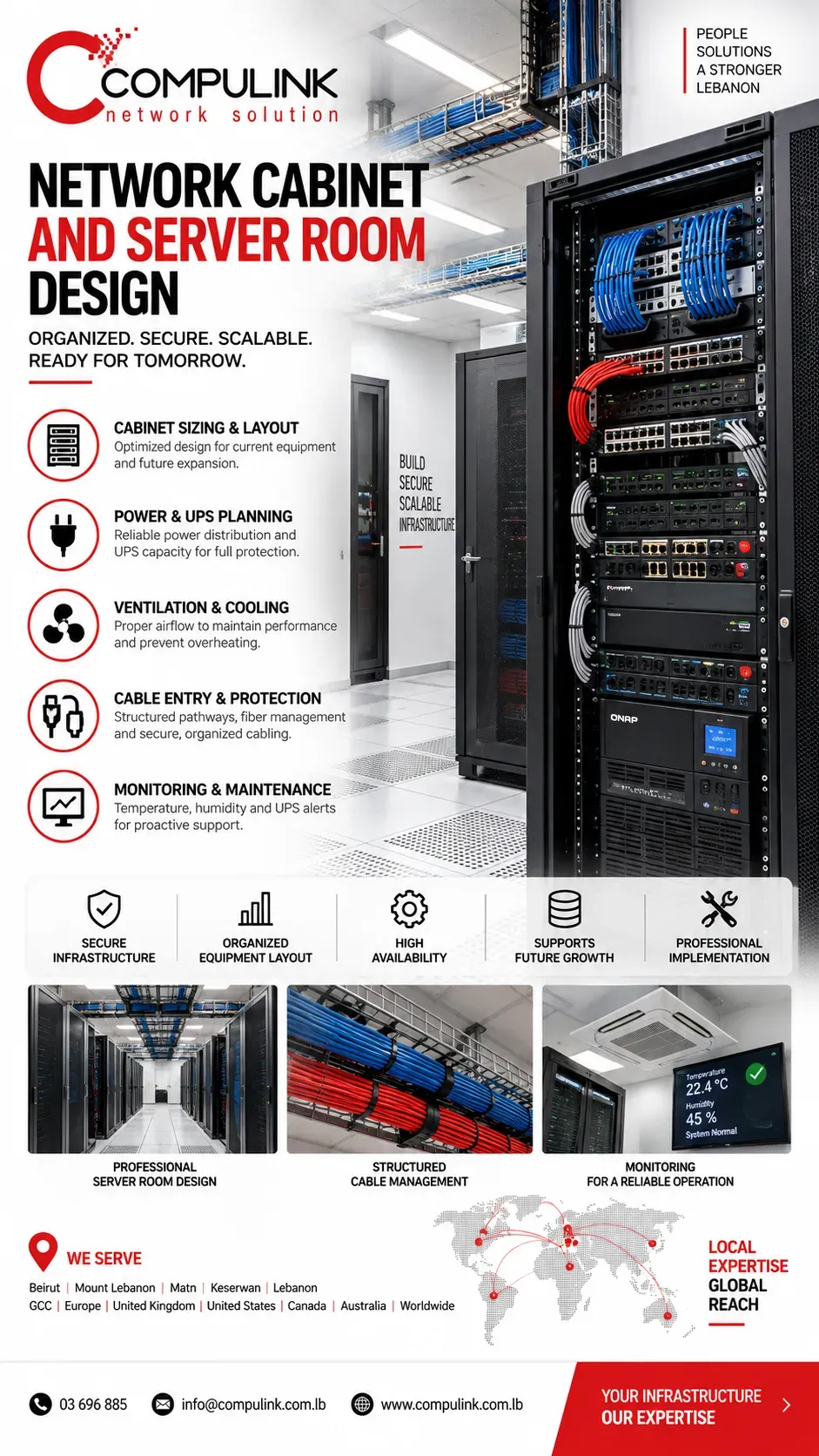
Network Cabinet and Server Room Design
Network cabinet and server room design creates a secure, organized environment for critical business equipment. Compulink calculates cabinet size, depth, load capacity and rack units according to patch panels, switches, firewalls, servers, storage systems, UPS equipment and future expansion.
Network cabinet equipment layout keeps patch panels, cable managers, switches and security appliances organized and accessible. Correct spacing and positioning allow technicians to maintain or replace equipment without disturbing the complete infrastructure.
Power distribution and UPS planning protect equipment against unstable electricity and short interruptions. Compulink evaluates equipment consumption, UPS capacity, runtime, grounding and safe power distribution before the cabinet enters operation.
Server room ventilation and cooling are planned according to equipment heat output and room conditions. Proper airflow reduces overheating, unexpected shutdowns, performance problems and premature equipment failure.
Cable entry and physical protection include pathway planning, fiber optic bend-radius control, separation from electrical power, cabinet anchoring and controlled access. Clear labeling and technical documentation support faster maintenance, troubleshooting and future
expansion.Compulink provides Network Cabinet and Server Room Design across Beirut, Mount Lebanon, Matn, Keserwan, Lebanon, the GCC, Europe, the United Kingdom, the United States, Canada, Australia, and Worldwide.
Server room monitoring and maintenance access help identify developing problems before business operations are affected. Compulink plans temperature and humidity monitoring, UPS alerts, equipment clearance and safe service access so technicians can inspect, replace or upgrade components.

Network Installation and Quality Control
Network installation and quality control transform an approved infrastructure design into a reliable working system. Compulink coordinates cable pathways, equipment locations, network cabinets, power requirements and installation sequencing before work begins, reducing disruption and preventing changes during the project.
Structured cabling installation follows planned routes, cable lengths, separation distances, bend-radius limits and containment capacity. Copper and fiber optic cables are protected from excessive pulling tension, sharp bends, electrical interference and physical damage while every connection is labeled at both ends.
Network termination and cabinet assembly include patch panels, outlets, fiber ODFs, cable managers, switches, firewalls, servers and UPS equipment. Compulink verifies termination quality, rack positioning, airflow, power distribution and service accessibility while maintaining clean, organized cable management.
Network quality-control inspections are performed throughout the installation—not only after completion. Technicians check cable routes, supports, labels, terminations, cabinet connections and installed devices before ceilings or pathways are closed. Problems are corrected immediately instead of remaining hidden until the network is operational.
Network commissioning and performance validation confirm that cabling, fiber links, switches, uplinks, WiFi access points, CCTV cameras and connected devices operate according to the design. Cable certification, fiber optic testing, connectivity checks, PoE verification and equipment status are documented for maintenance and future expansion.
Compulink provides
Network Installation and
Quality Control across
Beirut,
Mount Lebanon,
Matn,
Keserwan,
Lebanon, the
GCC,
Europe, the
United Kingdom, the
United States,
Canada,
Australia, and
Worldwide, delivering organized
Network Infrastructure built for dependable performance.

Technical Documentation and Testing Certification
Technical documentation and testing certification confirm that every installed cable, fiber link, network port and cabinet connection performs according to the approved infrastructure design. Compulink records the completed installation and validates critical links before the network is handed over.
Structured cabling testing and certification measure wire-map accuracy, cable length, insertion loss, return loss, crosstalk and overall link performance. Failed or marginal connections are corrected and retested so hidden termination faults do not become recurring network problems after operations begin.
Fiber optic testing and certification verify optical power, signal loss, connector quality, splice performance and link distance. Power-meter and OTDR results help identify excessive loss, damaged fiber, poor splices and bend-radius problems while establishing a reliable baseline for future troubleshooting.
Network equipment validation checks switch ports, uplinks, PoE delivery, firewall connections, WiFi access points, CCTV cameras, servers and connected devices. Compulink confirms link speed, power availability, connectivity and equipment status under realistic operating conditions before final acceptance.
Network technical documentation identifies cabinet layouts, patch-panel ports, outlet numbers, fiber cores, uplink routes, equipment connections and labeling references. Test reports, connection schedules and updated network records support faster troubleshooting, safer upgrades and future expansion.
Final inspection and project handover provide the business with verified results and a clear record of its installed infrastructure. This documentation simplifies maintenance, equipment replacement and fault recovery while protecting the network investment.
Compulink provides
Network Testing,
Structured Cabling Certification, and
Technical Documentation across
Beirut,
Mount Lebanon,
Matn,
Keserwan,
Lebanon, the
GCC,
Europe, the
United Kingdom, the
United States,
Canada,
Australia, and
Worldwide, delivering professionally tested
Network Infrastructure with dependable long-term performance,
industry-standard certification,
complete network documentation, and simplified future maintenance and expansion.

Cheap Network Infrastructure and the Long-Term Business Cost
Cheap network infrastructure may reduce the initial quotation, but weak design, low-quality materials and rushed installation often create greater costs after operations begin. Network failures rarely appear immediately; they develop as traffic increases, more devices connect and poorly selected components begin operating near their limits.
Low-quality network cabling can cause intermittent connections, reduced link speeds, packet loss and unstable PoE delivery. Incorrect cable categories, excessive distances, damaged conductors, poor terminations and unsuitable routes may affect WiFi access points, CCTV cameras, IP phones and computers months after installation.
Undersized network switches and PoE budgets create risk. A switch may have enough ports while lacking the power capacity, uplink bandwidth or switching performance required by connected devices. Cameras can restart, access points can become unstable and network traffic can slow down when business demand reaches the infrastructure.
Poorly planned network cabinets and cable pathways make every future repair more expensive. Unlabeled cables, crowded racks, blocked airflow and inaccessible equipment increase troubleshooting time and may require services to be disconnected before technicians can identify a single fault.
Network infrastructure rebuilding costs include more than replacement equipment. Businesses may face ceiling work, cable removal, new containment, interrupted operations, employee downtime and repeated installation charges. Saving money during the original project can therefore cost several times more later.
Compulink designs reliable network infrastructure according to business activity, device requirements, PoE demand, traffic capacity, security and future expansion.
We help organizations across Lebanon, the GCC, Europe, the United Kingdom, the United States, Canada, Australia, and Worldwide avoid repeated repairs, operational disruption, and expensive Network Infrastructure rebuilding.

What Businesses Receive from Compulink
Professional network infrastructure services from Compulink provide businesses with a complete, engineered solution rather than disconnected products and installation work. Every project begins with clear requirements, defined responsibilities and an infrastructure plan based on operations, connected devices, security needs and future growth.
A documented network design identifies cable categories, fiber optic backbones, equipment locations, network pathways, cabinet capacity, switching requirements, PoE demand, uplink performance, WiFi coverage and firewall connections. This gives management a clear understanding of what will be installed and why each component is required.
Coordinated network installation includes structured cabling, fiber termination, cabinet assembly, patch panels, cable management, equipment mounting, device connections and labeling. Compulink supervises installation quality and verifies that approved routes, distances, separation requirements and equipment layouts are followed correctly.
Testing and commissioning confirm the performance of copper cabling, fiber optic links, switch ports, uplinks, PoE devices, WiFi access points, CCTV cameras, servers and connected systems. Installation defects are corrected before handover instead of becoming operational problems later.
Technical documentation provides cabinet layouts, port references, cable labels, fiber records, test results and equipment connection information. These records support faster troubleshooting, safer upgrades, maintenance planning and future network expansion.
Compulink delivers reliable
Network Infrastructure Solutions across
Lebanon, the
GCC,
Europe, the
United Kingdom, the
United States,
Canada,
Australia, and
Worldwide.
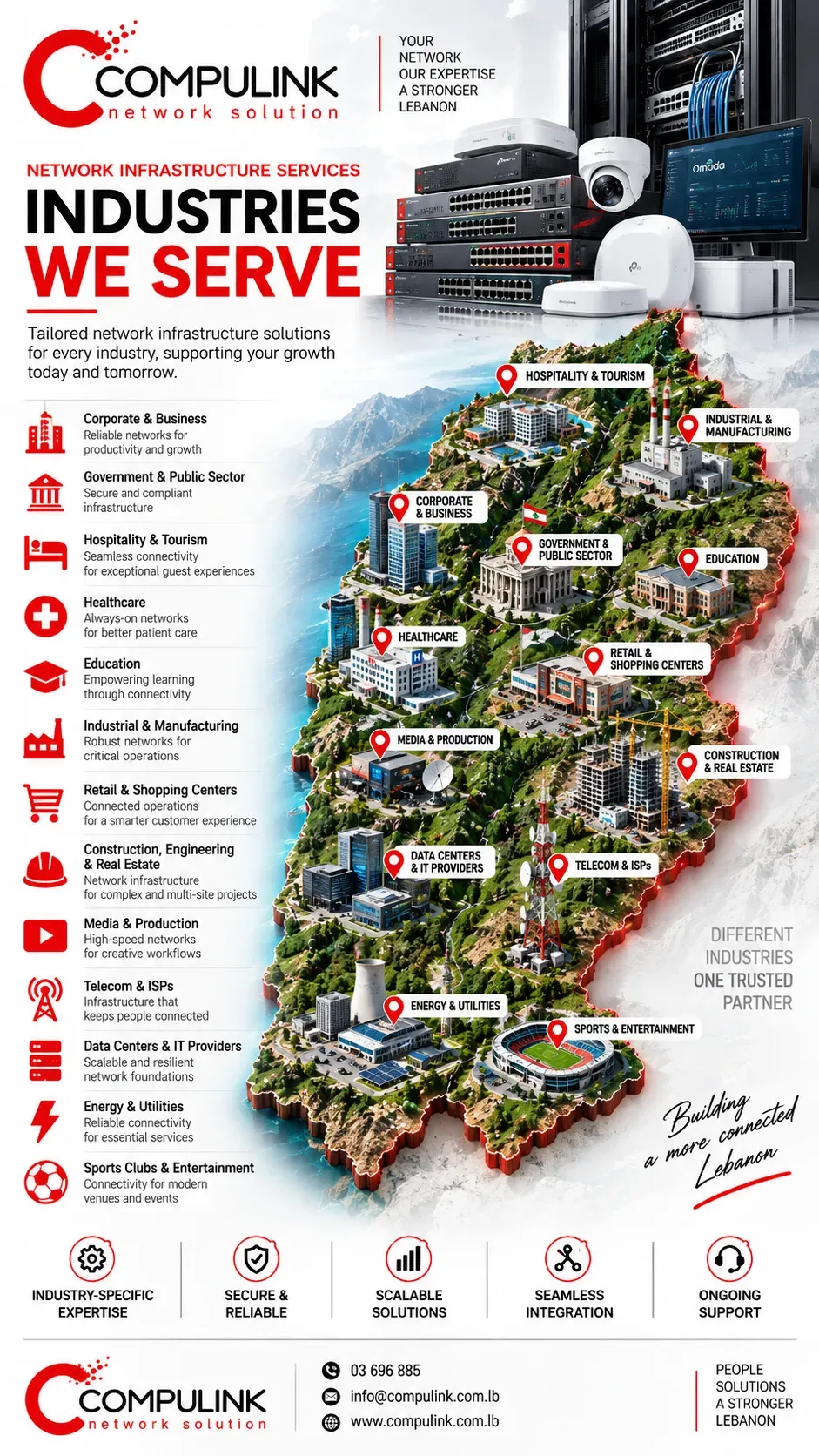
Industries and Areas We Serve
Network infrastructure services for corporate offices support daily communication, cloud applications, servers, storage, WiFi, CCTV and secure access. Compulink designs scalable business networks for small offices, headquarters, commercial buildings and multi-floor organizations.
Hotel, healthcare and education networks require dependable coverage, controlled access and continuous availability. We plan structured cabling, fiber backbones, guest WiFi, staff networks, surveillance systems and critical connections according to each facility’s operating requirements.
Retail stores, restaurants and shopping centers depend on stable connectivity for payment systems, inventory, customer WiFi, CCTV and management platforms. Network capacity and segmentation are planned to protect business operations while supporting connected devices.
Warehouses, factories and industrial facilities require durable cable routes, long-distance fiber links, PoE planning, protected cabinets and reliable coverage across challenging spaces.
Compulink evaluates distances, environmental conditions, equipment locations and future expansion before installation.
Media production companies and data-intensive businesses need high-speed networks for large file transfers, shared storage, editing systems, backup and media archiving.
We design copper and fiber infrastructure according to bandwidth, workflow and storage requirements.
Compulink provides professional
Network Infrastructure Services across
Lebanon, the
GCC,
Europe,
United Kingdom,
United States,
Canada,
Australia, and
Worldwide.
Our solutions serve corporate offices, hotels, schools, universities, clinics, hospitals, retail businesses, restaurants, warehouses, factories and media companies.
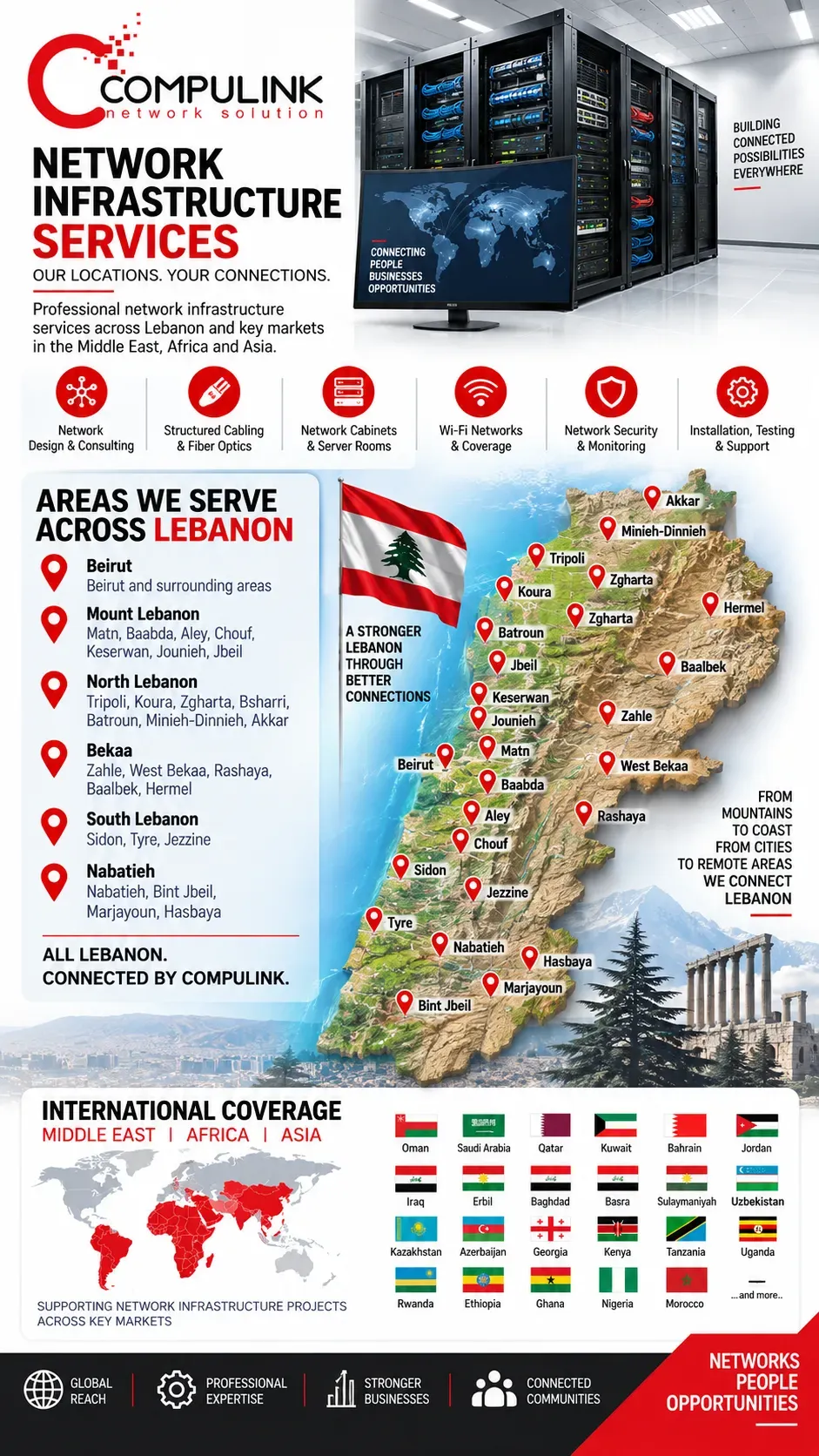
Network Infrastructure Services Across Lebanon and Worldwide
Compulink provides professional network infrastructure services across Lebanon, helping businesses, organizations, construction projects and commercial facilities build secure, reliable and scalable networks. Our coverage extends throughout Beirut, Mount Lebanon, North Lebanon, Bekaa, South Lebanon and Nabatieh, with infrastructure designed according to each site’s operational, performance and future expansion requirements.
Network Infrastructure Services Across Lebanon
Our Lebanon coverage includes Beirut, Matn, Baabda, Aley, Chouf, Keserwan, Jbeil, Tripoli, Koura, Zgharta, Bsharri, Batroun, Minieh-Dinnieh, Akkar, Zahle, West Bekaa, Rashaya, Baalbek, Hermel, Sidon, Tyre, Jezzine, Nabatieh, Bint Jbeil, Marjayoun and Hasbaya, together with surrounding towns and communities. Compulink supports projects across the country, from dense commercial districts and business centers to hotels, hospitals, schools, industrial facilities, residential developments and remote locations.
Our services include network design, structured cabling, fiber optic infrastructure, network cabinets, server rooms, switches, Wi-Fi, network security, testing, documentation and infrastructure upgrades.
Each project is planned around the building, business requirements, available pathways, equipment capacity and long-term network growth.
From central Beirut to mountain communities, coastal cities, northern districts, Bekaa locations and southern regions, our geographic coverage supports businesses wherever dependable network infrastructure is required in Lebanon.
Network Infrastructure Services Across the Middle East, Africa and Asia
Beyond Lebanon, Compulink targets infrastructure projects across the Middle East, GCC, Africa, Central Asia and Asia, including Oman, Saudi Arabia, Qatar, Kuwait, Bahrain, Jordan, Iraq, Erbil, Baghdad, Basra, Sulaymaniyah, Uzbekistan, Kazakhstan, Azerbaijan, Georgia, Kenya, Tanzania, Uganda, Rwanda, Ethiopia, Ghana, Nigeria and Morocco.
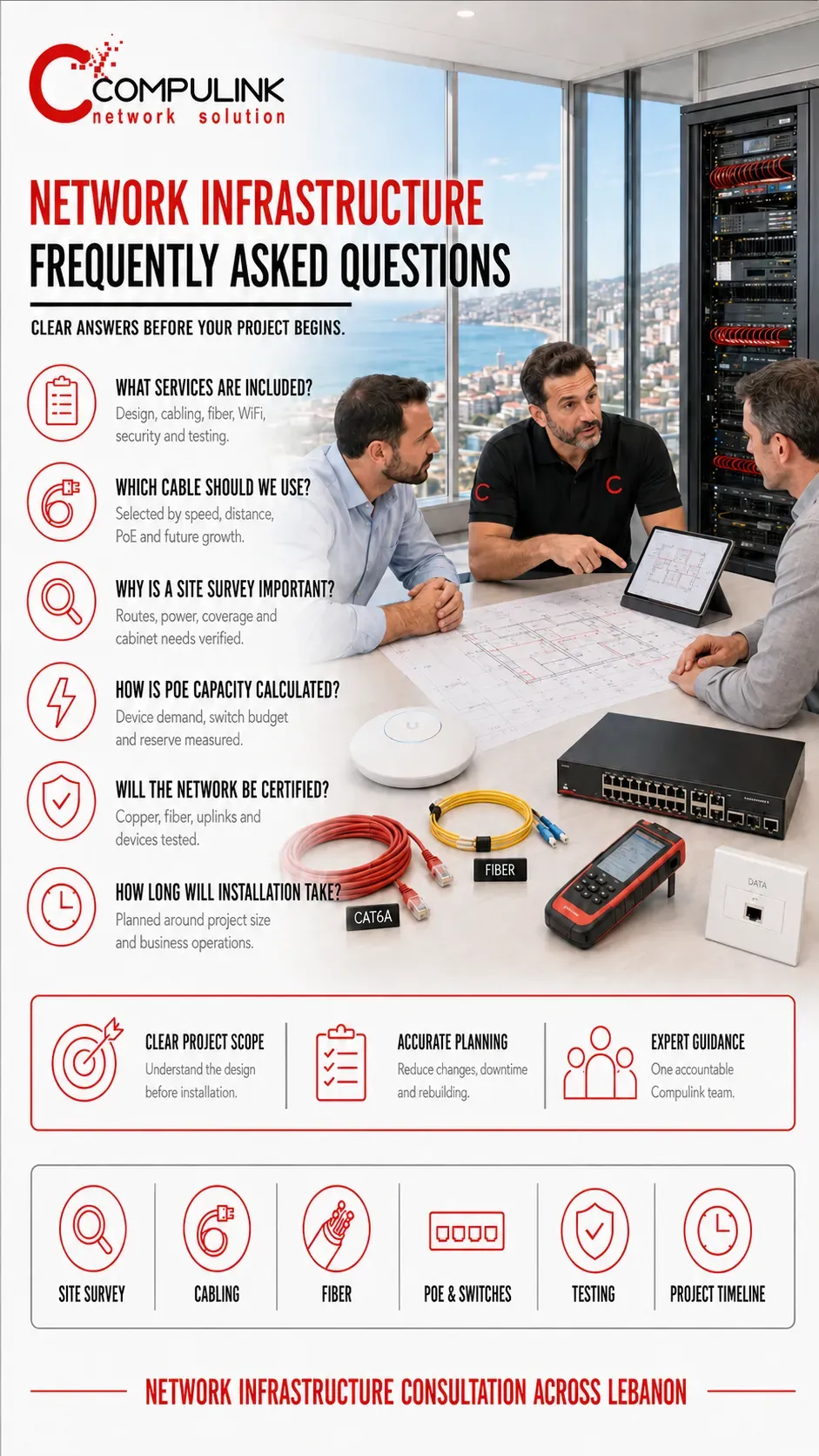
Network Infrastructure Services Frequently Asked Questions
What do network infrastructure services include?
Compulink provides site surveys, network design, structured cabling, fiber installation, cabinets, switches, WiFi, PoE planning, firewall integration, testing, documentation and handover.
How is the correct network cable selected?
Cable selection depends on speed, distance, interference, connected devices, PoE demand and future expansion. Compulink determines whether copper cabling or fiber optic infrastructure is suitable.
Why is a network site survey necessary?
A site survey identifies cable routes, distances, equipment locations, power, WiFi coverage and cabinet requirements before installation, reducing unexpected changes and rebuilding.
How is switch and PoE capacity calculated?
We calculate device consumption, per-port power, total PoE budget, switching capacity, uplink bandwidth and future reserve. Port quantity alone cannot confirm switch suitability.
Will the network be tested and documented?
Yes. Compulink tests copper cables, fiber links, uplinks, PoE devices and connectivity. Cabinet layouts, port labels, test results and equipment connections are documented.
How long does installation take?
Duration depends on site size, cable quantities, pathways, operating hours and equipment availability. Installation is sequenced to reduce business disruption while maintaining quality.
Compulink provides Network Infrastructure Services across Lebanon, the GCC, Europe, the United Kingdom, the United States, Canada, Australia, and Worldwide.
Network Infrastructure Consultation in Lebanon
Professional network infrastructure consultation helps businesses make the correct technical decisions before purchasing equipment or beginning installation. Compulink evaluates your operations, connected devices, data traffic, security requirements, building layout and future expansion to develop a practical infrastructure plan.
Whether you are preparing a new office, upgrading an existing network or correcting recurring connectivity problems, our specialists assess structured cabling, fiber optic requirements, WiFi coverage, CCTV connections, PoE demand, switching capacity, firewall performance, network cabinets and server-room conditions.
A consultation can identify hidden risks before they become expensive failures. You receive clear recommendations based on business requirements, installation conditions and long-term performance, not unnecessary equipment or temporary solutions.
Request a professional network site survey to discuss your project, compare available options and understand the infrastructure your organization genuinely needs.
Compulink provides
Network Infrastructure Consultation,
Design, and
Installation across
Lebanon, the
GCC,
Europe, the
United Kingdom, the
United States,
Canada,
Australia, and
Worldwide.
Contact Compulink today to plan a reliable, secure and scalable business network built correctly from the beginning.
Request a Network Site Survey →